Classical vs. Contemporary Pilates Certification Guide 2026
Classical and Contemporary certifications shape instructor careers differently. What studios actually hire for, what you'll earn, and how to choose the right path.

Key Takeaways
- Classical Pilates certifications train instructors in the complete original repertoire as Joseph Pilates designed it, typically requiring 500–600 hours and $3,700–$6,000+ over 9–18 months, while Contemporary programs adapt the method using modern biomechanics and rehabilitation science.
- Reformer certification is now essential for studio hiring in 2026, as nearly 40% of studio owners report needing more Pilates instructors, with reformer-trained instructors commanding premium compensation.
- Average annual pay for Pilates instructors in the United States reaches $70,426 as of May 2026, with comprehensive certification holders earning significantly more than entry-level practitioners, and the 75th percentile reaching $86,000.
- Studio hiring decisions focus on teaching ability over certification brand name in most markets, though the Nationally Certified Pilates Teacher (NCPT) credential represents the industry's highest third-party standard.
- Market positioning differs sharply: reformer Pilates holds approximately 36% market share due to equipment-based appeal, while classical Pilates attracts roughly 25% of practitioners who prioritize traditional techniques and lineage.
What Classical and Contemporary Certifications Actually Teach
A Classical Pilates certification trains instructors in the complete original repertoire as Joseph Pilates designed it, covering mat work and all major apparatus within a documented lineage. Classical Pilates holds that Joseph Pilates created a finished system that does not need supplementation, where every exercise and sequence serves a specific purpose within a larger architecture.
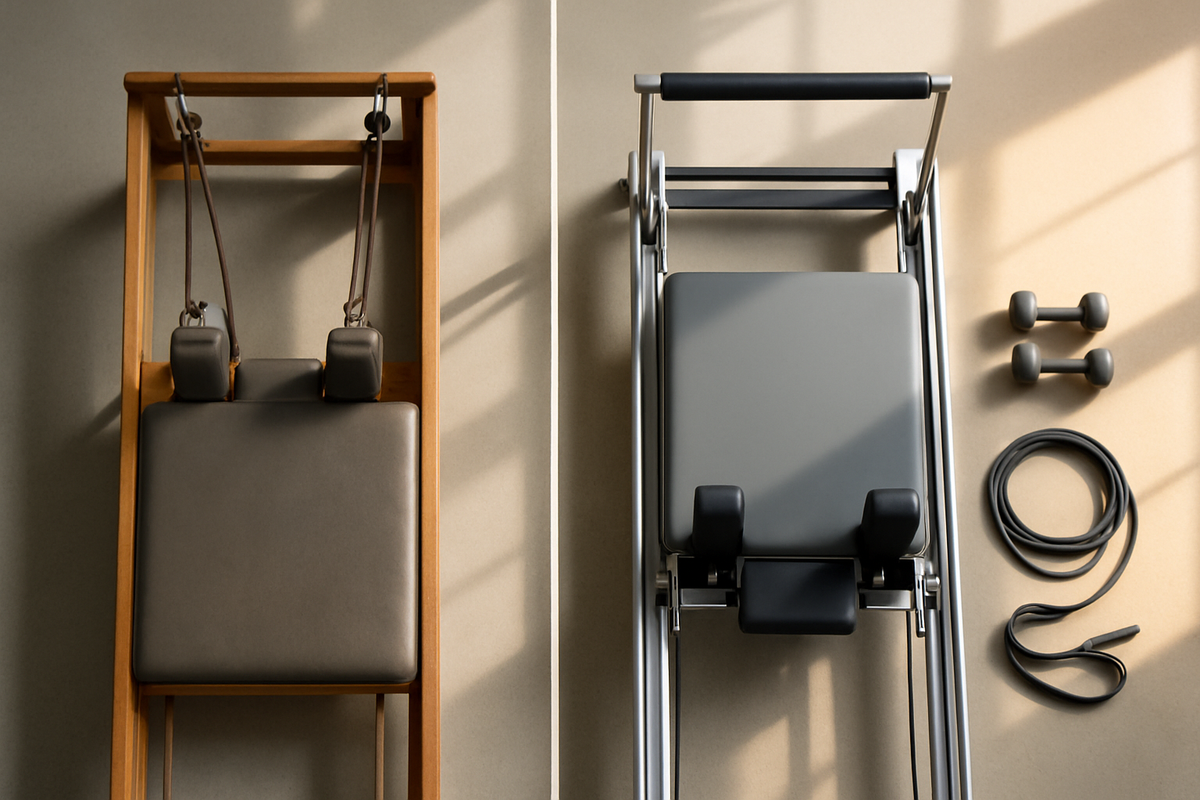
Contemporary Pilates takes a different approach. Contemporary programs modify exercises, introduce new movements and props, and teach biomechanical principles that post-date Pilates' original work. The methodology integrates modern physical therapy, sports science, and movement research with the original framework. Contemporary instructors use traditional Pilates equipment plus props, bands, balls, weights, and sometimes unconventional tools that were not part of the original system.
The practical difference shows up in class structure. In classical instruction, a Tower Class follows a predictable flow of mat and spring elements, typically starting lying down and ending standing. Contemporary classes vary week to week, with no two sessions following the same pattern. This structural difference reflects the underlying philosophical divide between preservation and adaptation.
Training Requirements and Industry Standards
A comprehensive certification covering all apparatus and qualifying instructors for the NCPT exam typically requires 1–2 years of part-time study and 500–600 logged hours. Comprehensive Pilates certification now costs $3,700–$6,000+ and takes 9–18 months, with reformer training essential for 2026 studio hiring and premium compensation.
A 600-hour classical certification from a recognized program typically includes the complete mat repertoire across all three levels, all major apparatus (Reformer, Cadillac, Chair, Barrels), observation hours, self-practice, and apprenticeship hours with real clients. Lineage documentation traces the instructor's teaching lineage back to Joseph Pilates through their teachers.
The Pilates Method Alliance Certification, now officially recognized as the Nationally Certified Pilates Teacher (NCPT) credential, represents the highest professional standard in the Pilates industry. Unlike certificate-of-completion programs offered by individual schools, this is a third-party, NCCA-accredited certification that validates a teacher's knowledge, skills, and ability to provide safe and effective instruction. The NCPT is separate from your training school's certificate and demonstrates mastery beyond any single program's standards.
What Studios Actually Hire For in 2026
The honest test is to look at hiring requirements posted by three to five studios in your city. If four out of five want BASI, Stott, or Polestar, your certification decision narrows quickly. If most post "recognized Pilates certification," which is what the majority of US studios actually require in 2026, your choice opens up considerably.
The big classical and contemporary schools (BASI, Stott, Polestar, Romana's) carry industry recognition built over decades. This recognition proves particularly useful for instructors who want maximum credential portability across markets or who plan to teach internationally. However, national accreditation often is not the deciding factor when studios hire instructors.
Many studio owners prioritize instructors who can cue clearly, manage mixed-level classes safely, adapt exercises in real time, and lead strong, confident sessions. What you can do as a teacher often matters more than the name on your certificate. Nearly 40% of studio owners say they need more Pilates instructors, and 30% are currently hiring, creating significant opportunity for well-trained instructors regardless of methodological lineage.
Earning Potential Across Certification Types
As of May 2026, the average annual pay for a Pilates Instructor in the United States is $70,426, with the majority of salaries ranging between $48,000 (25th percentile) to $86,000 (75th percentile). These figures represent significant growth in instructor compensation as demand outpaces supply.
Instructors with comprehensive certification from reputable organizations such as STOTT Pilates, BASI Pilates, or Balanced Body often earn more than those with basic or entry-level qualifications. Seasoned instructors with five or more years of experience are typically in higher demand and can charge premium rates. Reformer-certified instructors often earn more due to equipment specialization, reflecting market demand for apparatus-based instruction.
The compensation differential stems partly from market positioning. Reformer Pilates accounts for approximately 36% market share due to its equipment-based appeal and perceived premium positioning. Demand for reformer Pilates classes specifically is rising at a rate that outpaces the broader studio market, driven by growing consumer awareness of the neuromuscular conditioning outcomes that reformer-based resistance work produces compared to mat-based formats.
Market Positioning and Client Perception
Clients initially do not distinguish between classical and contemporary approaches. To most consumers, Pilates is Pilates, and with the proliferation of hybrid formats and branded derivations, the method has become increasingly diffuse in public perception. Private Pilates sessions at major fitness chains became the most waitlisted class in some companies' history, with dedicated Pilates studios being incorporated into 12 to 14 planned new locations in 2026.
The commercial fitness industry has attached the Pilates name to a much wider range of products in recent years: reformer-only group classes, hybrid formats, and short-form certifications that draw on the equipment and vocabulary without teaching the method in any systematic way. This market fragmentation makes the classical-contemporary distinction more operationally significant for studio positioning, even as it remains invisible to most consumers.
Students are seeking classes that feel thoughtful, contemporary and creatively sequenced, with the future of Pilates blending classical principles with innovative class structure and intelligent variations. Teachers who develop their own style, experiment with flow, and understand how to progress and regress movement stand out in a busy market. As new demographics enter Pilates and group Reformer formats gain mainstream traction, the industry is shifting from niche to necessity.
What This Means for Studio Operators
Editorial analysis, not reported fact:
The classical-contemporary divide matters less as a philosophical debate and more as an infrastructure decision. For studio operators, the choice of which certifications to require or prefer shapes your instructor pool, class offerings, and market positioning. If your business model centers on lineage-based authenticity and premium private sessions, classical credentials signal that positioning to discerning clients. If you run high-volume reformer classes with creative sequencing and contemporary props, Contemporary-trained instructors may integrate more seamlessly.
The hiring landscape in mid-2026 favors flexibility. With 40% of studios reporting instructor shortages, operators who focus on teaching competence over certification pedigree access a wider talent pool. The practical test is whether an instructor can manage your specific class formats safely and effectively. A 600-hour classical certification does not automatically translate to strong group reformer instruction, just as a contemporary cert does not guarantee mastery of the full classical repertoire.
For instructors choosing a certification path, the decision hinges on local market demand and career goals. Research actual job postings in your geographic market before committing five-figure investment and 500+ hours. If your target studios uniformly require specific brand-name certifications, that reality outweighs methodological preference. If the market values teaching ability and NCPT certification over school pedigree, you gain more flexibility in choosing a training program that matches your learning style and philosophical inclination.
Sources & Further Reading
- Power Pilates: What is the Difference Between Classical and Contemporary Pilates, methodological overview from a classical lineage program
- Pilates Bridge: Classical vs Contemporary Pilates, comparative analysis of training approaches
- The Core Collab: How to Become a Pilates Instructor 2025 Guide, certification costs and timelines
- National Pilates Certification Program: NCPT Requirements, third-party certification standards
- ZipRecruiter: Pilates Instructor Salary, May 2026 compensation data
- Business Wire: New Research Shows Pilates is Booming, studio hiring trends and instructor demand
- Emergen Research: Pilates and Yoga Studios Market, market share analysis and growth trends
- Barre Body: Future of Pilates Teaching Trends 2026, evolving class formats and instructor differentiation
Editorial coverage of publicly reported industry developments. The Pilates Business has no commercial relationship with any companies named.