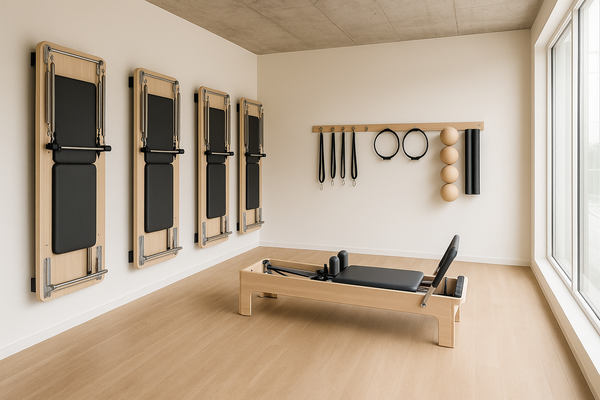
Group Reformer: 2026's Biggest Revenue Opportunity for Studios
Reformer Pilates jumped to #2 in fitness trends as big-box gyms enter the market. Why group reformer economics, instructor training, and second-visit conversion now determine studio survival.

Key Takeaways
- Group reformer classes have driven 35-40% monthly revenue increases for commercial fitness operators, transforming reformer from boutique add-on to mainstream necessity as big-box chains like Amped Fitness introduce dedicated reformer studios across the US.
- Reformer Pilates surged from #10 in 2024 to #2 in fitness trend rankings for 2025, while studio adoption climbed from 17% in 2021 to 45% by 2025, signaling a permanent shift from niche modality to core offering.
- Pricing arbitrage creates distinct revenue lanes: mat classes run $20-$30 per session while small-group reformer commands $30-$55+, reflecting equipment cost, maintenance overhead, and capped class sizes that limit scale but preserve margins.
- Instructor certification gaps now constrain growth, prompting Balanced Body Education to launch Group Reformer Training specifically for fitness instructors transitioning to apparatus work, creating new career ladders and competitive advantages for multi-certified teachers.
- Second-visit conversion, not first-time trial volume, determines reformer studio survival: industry data shows below-average return rates from visit one to visit two, though clients who reach visit three exhibit exceptionally strong retention.
- Connected reformers with AI feedback and digital integration are emerging as competitive moats, with NordicTrack's Ultra Reformer Series and iFIT's biomechanics platforms enabling hybrid membership models that blend in-studio and at-home experiences.
Why Group Reformer Economics Differ Fundamentally from Mat Classes
Reformer Pilates operates under a different cost and revenue structure than mat-based programming. According to pricing analysis published by Time2Book, large-group mat classes typically range from $20 to $30 per session, while small-group reformer classes command $30 to $55 or more per class. The premium reflects equipment acquisition costs, ongoing maintenance requirements, and physical space constraints that cap enrollment.
Yet these constraints also create margin protection. Balanced Body's analysis of commercial fitness operators found that reformer Pilates increased studio revenue by 35-40% per month. The higher per-class price point, combined with strong retention among clients who complete multiple sessions, offsets the inability to scale reformer classes to the 20- or 30-person capacities common in mat formats.
Market growth data compiled by Dojo Business identifies three revenue engines driving Pilates studio expansion: premiumization of reformer classes, hybrid memberships that bundle in-studio and digital access, and broadening adoption by men and clients aged 55-plus seeking low-impact, rehabilitative movement. Reformer's apparatus-based resistance and precision cueing appeal directly to these demographics in ways mat programming often does not.
How Big-Box Operators Are Competing for Boutique Studio Share
Amped Fitness introduced reformer-based formats like Aura Pilates to locations across the United States in 2026, according to Athletech News, bringing traditionally boutique experiences into mainstream gym settings. Similarly, LA Fitness now offers low-impact, full-body Reformer Pilates classes taught on Balanced Body Reformers, and Crunch announced a dedicated 1,300-square-foot reformer studio featuring over 10 machines in its upcoming McKinney, Texas location.
This migration from boutique to big-box changes competitive dynamics. Large operators leverage existing membership bases, cross-sell reformer classes to current gym members, and absorb equipment costs across broader revenue streams. Club Pilates memberships start at $100 per month for unlimited classes, a price point that undercuts many independent studios while still preserving per-class margins through volume.
For boutique operators, the implication is clear: competing on price alone is unsustainable. Differentiation must come through instructor expertise, specialized programming for clinical populations, community building, and hybrid models that blend live and digital touchpoints.
Instructor Certification Gaps Create Bottlenecks and Career Ladders
High demand for group reformer classes has collided with a shortage of qualified instructors. Balanced Body Education created a Group Reformer Training program explicitly to upskill instructors already teaching in fitness settings, enabling them to design and deliver engaging, results-driven group reformer classes without completing full comprehensive Pilates certifications.
This training pathway reflects broader industry needs. Instructors increasingly seek certification on apparatus to teach multiple modalities, positioning themselves for higher-paying roles and more resilient career trajectories. Studios that invest in upskilling current staff gain operational flexibility and reduce dependency on external hiring in a competitive labor market.
The gap also creates strategic hiring advantages. Studios that can offer mentorship, apparatus training, and clear advancement from mat to reformer instruction will attract talent more effectively than those treating instructors as interchangeable contractors.
Hybrid Memberships and Technology as Competitive Moats
iFIT predicts that future machines will fuse biomechanics, AI, and human-centered design to create training experiences that are as intuitive as they are effective, according to Athletech News coverage of 2026 equipment forecasts. The NordicTrack Ultra Reformer Series, a commercial-grade, digitally connected reformer with smart-spine technology, tracks every move and provides real-time feedback.
Connected equipment enables hybrid membership models that extend studio relationships beyond physical class attendance. Clients can access on-demand reformer workouts at home, receive personalized progression tracking, and maintain engagement during travel or schedule disruptions. This continuity improves lifetime value and insulates studios from the volatility of drop-in traffic.
Hybrid memberships combining in-studio and digital access are now identified as one of three core growth engines for Pilates studios, alongside reformer premiumization and demographic expansion. Studios that treat digital as a separate product line, rather than an integrated retention tool, risk ceding this advantage to competitors.
Second-Visit Conversion: The Silent Metric Determining Reformer Studio Survival
Analysis published in Mariana Tek's 2026 Pilates Trends Report revealed that the return rate from first visit to second visit is slightly lower than average among Pilates consumers. However, clients who continue beyond their first two visits demonstrate exceptionally strong retention.
This pattern points to a critical inflection point. Studios optimizing for first-time trial volume without structured onboarding, follow-up, and early progression support will see high churn. The cost of acquiring a new client through paid advertising, partnerships, or promotions is wasted if that client does not return for a second class.
Operationally, this means reformer studios must design explicit second-visit conversion strategies: post-class follow-up communication, intro series pricing that incentivizes multiple bookings upfront, instructor training on beginner retention cues, and scheduling systems that prompt clients to book their next session before leaving the studio. The difference between a 30% second-visit conversion rate and a 60% rate compounds rapidly across client lifetime value.
What This Means for Studio Operators
Editorial analysis — not reported fact:
If you operate a mat-only studio, 2026 is the year to model reformer economics seriously. The 35-40% revenue lift is not speculative; it is being realized by commercial operators right now. The question is whether you can capture that upside before a big-box competitor opens nearby and absorbs your trial traffic. Start by running the numbers: equipment lease versus purchase, square footage per reformer, realistic class sizes, and instructor capacity. If the unit economics work, the barrier is execution, not viability.
If you already offer reformer classes, audit your second-visit conversion rate this month. Pull data from your booking system for the past 90 days. Calculate the percentage of first-time clients who returned for a second session within 30 days. If that number is below 50%, you have a retention problem that no amount of marketing spend will fix. Build a post-class communication sequence, test intro package pricing that requires advance booking of multiple sessions, and train instructors to explicitly invite new clients back.
For instructors, group reformer certification is now a career differentiator, not a niche credential. Studios need you, and the training pathways are more accessible than they were even two years ago. If you are currently mat-certified or teaching group fitness formats, investing in apparatus training will increase your hourly rate, expand your employment options, and future-proof your income as reformer demand continues to outpace qualified instructor supply.
Finally, if you are considering technology investments, evaluate connected reformers and hybrid membership platforms through the lens of retention, not novelty. The studios that will win in this market are those that keep clients engaged between in-person visits, provide measurable progression feedback, and create switching costs that make leaving for a competitor inconvenient. Technology that does not serve those goals is overhead, not infrastructure.
Sources & Further Reading
- Pilates Journal: 2026 Pilates Predictions from Industry Leaders — trend analysis and forward-looking insights from studio operators and educators
- Athletech News: Pilates and the 2026 Equipment Forecast — coverage of AI-integrated reformers and biomechanics technology from iFIT and other manufacturers
- Athletech News: Amped Fitness Adds Reformer Pilates — reporting on big-box gym adoption of reformer formats including Aura Pilates rollout
- Mariana Tek: 2026 Pilates Trends Report — data on second-visit conversion rates and retention patterns among Pilates clients
- Balanced Body: Group Reformer for Commercial Fitness — case studies on revenue impact and instructor training programs for group reformer delivery
- Dojo Business: Pilates Studio Market Growth — studio adoption statistics and analysis of revenue drivers including hybrid memberships and demographic expansion
- NordicTrack: Pilates Is Entering a New Era — product overview of Ultra Reformer Series with smart-spine tracking and connected technology features
- Time2Book: Pilates Class Pricing Guide — comparative pricing analysis for mat versus reformer classes and membership models
- Wellsphere: Pilates Instructor Requirements, Certification, Salary & Career 2026 — career pathway analysis and certification landscape for Pilates instructors
Editorial coverage of publicly reported industry developments. The Pilates Business has no commercial relationship with any companies named.