How Many Reformers Should a New Pilates Studio Buy?
Space, instructor capacity, and phased growth determine optimal reformer count. Start with 4-6 machines, expand at 80% utilization to avoid capital traps.

Key Takeaways
- Reformer count depends on space first, instructors second: A 1,000 sq ft room realistically fits 5-6 reformers with proper clearance, requiring 40-50 sq ft per machine plus 300-500 sq ft for reception and circulation.
- Equipment investment ranges from $20,000 to $100,000: Commercial-grade reformers cost $2,500-$8,000 each, representing 30-40% of total startup costs for studios opening with 8-12 machines.
- Phased purchasing beats upfront overinvestment: Studios adding reformers only after reaching 80% capacity utilization avoid tying up capital in idle equipment while debt service runs.
- Instructor capacity limits equipment ROI: Six reformers support a testable class schedule, but the bottleneck is staffing expertise, not floor space, as instructor burnout accelerates when teaching exceeds sustainable loads.
- Waitlist depth signals expansion timing: Consistent waitlists of 4-6 clients per class session justify adding machines or time slots, especially when 41% of churned clients cite schedule conflicts as their primary exit reason.
- Market saturation demands precision: With studio count growth at only 0.2% in 2026 while reformer Pilates bookings grew 66% year-over-year, success separates on capacity management and scheduling sophistication, not reformer count alone.
The Space Reality: Square Footage Dictates Machine Count
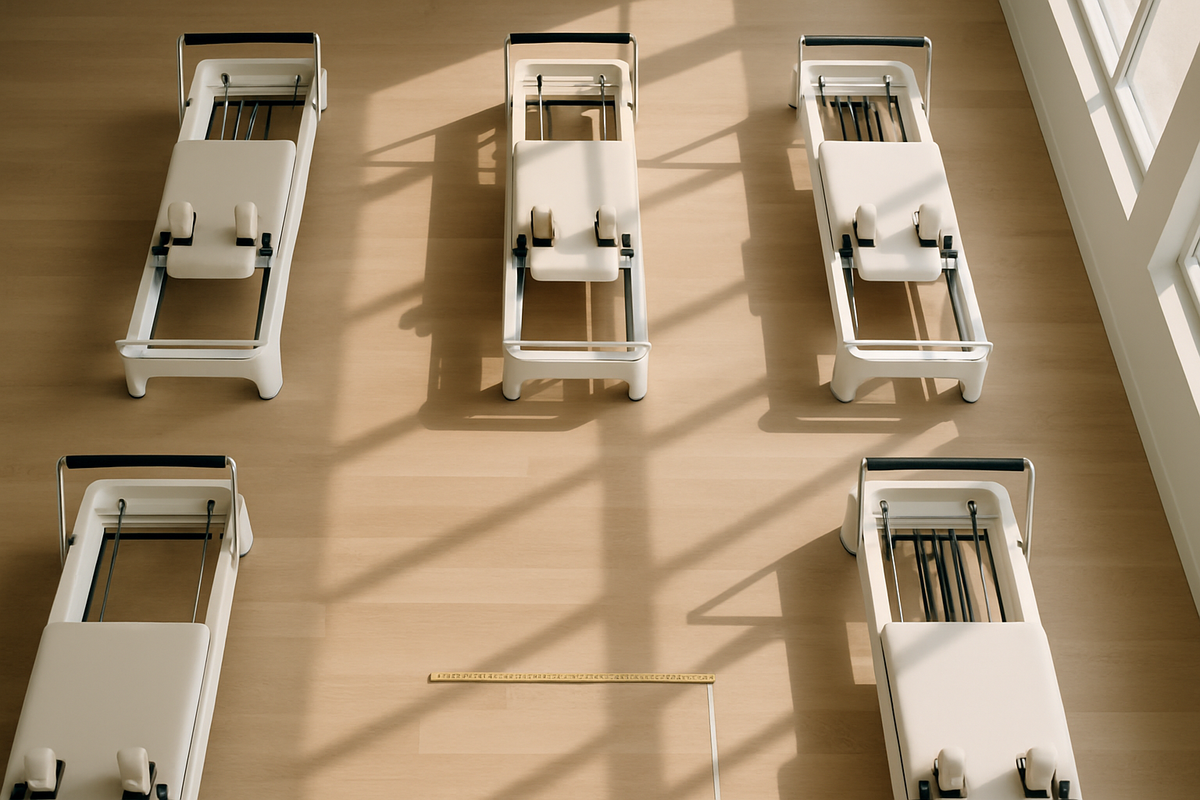
The physical layout determines your ceiling before you consider demand or budget. A 1,000 sq ft room realistically fits 5-6 reformers with proper clearance, not the 8-10 that appear possible on paper. Each reformer requires 40 to 50 sq ft for the workout floor, plus an additional 300 to 500 sq ft for reception, storage, changing areas, and circulation paths.
Aisle width matters more than new owners anticipate. The aisle between reformer rows needs at least 3 ft width for an instructor to move freely during class. An instructor in motion occupies more space than one standing still, and underestimating this clearance creates operational friction from day one.
Real-world examples confirm these constraints. A profitable 500 sq ft Brooklyn reformer Pilates studio serves 50 members with 5 reformers and 5 chairs, generating a $144,000 current run rate. Meanwhile, an established Greenville, SC boutique studio uses 2,500 sq ft with 4 convertible reformers and 7 tower units. The lesson: layout efficiency and demonstrated demand outperform raw machine count.
Equipment Cost and Capital Allocation
Commercial-grade reformers run $3,500-$8,000 each, and for a group reformer studio with eight machines, that represents $28,000-$64,000 just in reformers before accounting for towers, chairs, mats, or auxiliary equipment. Reformer equipment comprises 30 to 40 percent of total startup cost, making this decision one of the largest single capital commitments in studio development.
The investment range widens with studio scale. A single commercial-grade reformer costs between $2,500 and $8,000 depending on brand and configuration, and for a studio opening with 8-12 reformers, that totals $20,000 to $100,000 just on beds. This front-loads capital requirements at a stage when cash flow remains unproven and independent studio startup costs already stretch $200,000 to $300,000 all-in for confirmed-whitespace markets.
Standard Configurations by Studio Model
Four reformers work for cautious private or boutique starts, six can support a stronger small-group model, eight often fits a dedicated group reformer room, and ten or more usually belongs to larger capacity, dense scheduling, or multi-room planning. A 4-reformer studio runs private sessions and duets comfortably, while 6 reformers allow small group classes of 4-5 students while keeping one machine available for privates.
Small boutique studios may start with 4-6 reformers, while larger group class studios may open with 8-12 or more. The configuration reflects business model more than market size: privates and duets require fewer machines but command higher per-session pricing, while group reformer classes demand more equipment but generate revenue through volume and scheduling density.
Phased Growth Beats Upfront Overinvestment
A phased purchasing strategy where additional reformers are added only as membership and demand grow helps align equipment investments with the studio's actual growth and revenue development. One studio operator noted the 80% threshold: "If I can start with these four reformers, when I have 80% of my classes full, or nearly full, that's when I'm going to add the next reformer."
This approach addresses the 2026 paradox of strong demand signals amid market saturation. Reformer Pilates bookings grew 66% year-over-year, yet studio count growth from 2025 to 2026 was only 0.2% while industry revenue declined 0.8%. Success in this environment requires matching equipment investment to demonstrated demand rather than projected capacity.
The practical benefit: avoiding idle equipment while paying debt service. It is better to start with a layout you can fill consistently than to overinvest in machines before demand is proven. Studios that lock in eight reformers at opening often find two or three sit unused during off-peak hours, tying up $16,000-$24,000 in capital that could fund instructor training, marketing, or operational reserves during the critical first six months.
Demand Signals: When Waitlists Justify Expansion
Waitlist depth provides the clearest expansion signal. If a Tuesday 5:30pm reformer class has a waitlist of 4-6 people every week, that is enough demand to justify adding a 6:30pm session. The data on churn reinforces urgency: 41% of churned clients cite schedule conflicts as the primary exit reason, meaning insufficient reformer capacity during peak windows directly drives attrition.
Peak-hour utilization illustrates the pattern. Life Time's CTR athletic reformer class became the most waitlisted class in company history, with reformer classes hitting 98% utilization at 6 PM while 10 AM slots sit at 45%. This time-of-day variance means the bottleneck often is not total reformer count but scheduling sophistication and capacity utilization and scheduling across the day.
Waitlist demand skews heavily toward reformer classes compared to mat sessions, concentrating pressure on equipment-dependent sessions. Studios that cannot accommodate this demand lose clients to competitors or alternative modalities, making the reformer-count decision inseparable from retention strategy and lifetime value calculations.
Instructor Capacity: The True Bottleneck
Six is enough to test a location and build a class timetable without overcommitting on equipment spend, while the right number depends on how many classes you can realistically staff, not just the size of the room. Ten reformers mean nothing if you have two instructors who can each teach 12 sessions per week before burnout accelerates.
The instructor load ceiling appears quickly. Within a year or two, teachers become booked solid with huge waitlists, but when instructors don't have capacity to handle an overabundance of students, it drains them quickly, and teaching too many classes in a day or week leads to burnout. Studios that buy equipment ahead of their instructor pipeline create a mismatch between advertised capacity and deliverable sessions, damaging reputation and search visibility when classes are cancelled or consolidated.
The financial implication: reformer ROI depends on instructor availability, not just client demand. A studio with eight reformers but insufficient teaching capacity to run four daily sessions operates at 50% equipment utilization, doubling the effective cost per reformer hour. Phased equipment growth allows hiring and training to pace machine acquisition, maintaining quality and instructor retention while expanding capacity.
What This Means for Studio Operators
Editorial analysis, not reported fact:
The reformer-count decision in 2026 separates disciplined operators from optimistic overspenders. With industry revenue declining 0.8% even as bookings surge 66%, the market rewards precision over scale. Start with the minimum viable configuration for your space and instructor capacity: 4-6 reformers for boutique privates and small groups, 6-8 for dedicated group reformer studios with proven instructor pipelines.
Monitor your 80% utilization threshold weekly by session, not just by aggregate occupancy. If Tuesday 6 PM consistently waitlists while Wednesday 10 AM runs at 40%, the answer is not more reformers but better scheduling or off-peak incentives. Only when peak sessions fill to 80%+ for four consecutive weeks should you trigger reformer expansion or additional session creation.
Financially, treat reformers as equipment with 7-10 year useful lives but 2-3 year payback requirements. At $5,000 average cost per reformer and $40 average revenue per reformer hour, a machine needs 125 client-hours to break even before considering space costs, instructor wages, or maintenance. A reformer sitting idle three hours per day extends payback by 50%, turning a defensible investment into a capital drag during the critical first year when cash flow determines survival.
Sources & Further Reading
- Hesure Pilates: How Many Reformers Does a Studio Need?, phased purchasing strategies and studio operator quotes
- Megacore Pilates: How Many Reformers for a Pilates Studio, standard configurations by studio type
- Mariana Tek: A Guide to Modern Pilates Studio Design, space requirements and layout guidelines
- BSport: Equipment Costs and Class Size for Reformer Pilates Studios, equipment as percentage of startup costs
- Pilates Bridge: Waitlist Capacity Studio Management, demand signals and instructor capacity constraints
- VibeFam: How Much Does It Cost to Open a Pilates Studio in 2026?, reformer pricing and capital requirements
- SchedulingKit: Pilates Industry Statistics, booking growth and market trends
- MMC Invest: U.S. Reformer Pilates Market Outlook 2026, studio count and revenue trends
- The Pilates Business: Peak vs. Off-Peak Scheduling, utilization rates and waitlist patterns
- The Pilates Business: The Hidden Math Behind Pilates Client Acquisition, churn reasons and schedule conflict data
Editorial coverage of publicly reported industry developments. The Pilates Business has no commercial relationship with any companies named.