Pilates Studio Market 2026: Franchise Growth & Unit Economics
Pilates Addiction projects 125 studios in 2026, JETSET awarded 92 Q1 territories, and Club Pilates signed a 70-unit deal—while U.S. revenue fell 0.8% and only 9.4% of studios clear 20% margins.


Key Takeaways
- Pilates Addiction franchise growth: The brand projects 125 studios to open in 2026 after launching franchising in June 2025, powered by proprietary Aurum Reformer™ equipment and more than $1.34 million in active educator sponsorships systemwide.
- JETSET Pilates expansion velocity: The brand awarded 92 new territories in Q1 2026 alone, surpassing 350 total territories awarded while achieving a 2025 systemwide average unit volume of approximately $1.13 million.
- Club Pilates 70-studio franchise deal: Renew Fitness, backed by Saber Ammori and Cohere Capital, committed to a 70-location expansion in Maryland, Michigan, and New York, requiring an estimated capital outlay between $31 million and $63 million based on per-unit investment ranges of $385,000 to $839,000.
- Profitability paradox in 2026: U.S. studio count grew just 0.2% while industry revenue declined 0.8%, yet Pilates studios still report the highest profit margins among modalities, with only 9.4% of studios achieving 20%+ margins despite premium pricing power.
- Design as competitive advantage: Luxury concepts like Reforming Pilates are investing in multimillion-dollar, 7,000-square-foot flagship locations, while neutral-toned interiors and proprietary equipment create brand differentiation in an increasingly saturated market.
Franchise Titans Racing to Lock Territory: JETSET, Pilates Addiction, and Club Pilates Lead 2026 Expansion
The Pilates Addiction franchise, launched in June 2025, has become one of the fastest-growing concepts in boutique fitness, with 125 studios projected to open in 2026. The brand, part of Anthony Geisler's Sequel Brands and led by former Club Pilates executive Sarah Luna, differentiates itself through a flashy black-and-gold color scheme and proprietary WundaFormer machines exclusive to its franchisees.
JETSET Pilates opened 24 new studios in 2025 across Texas, Florida, Georgia, North Carolina, New Jersey, Massachusetts, Colorado, and Washington, D.C. By Q1 2026, the brand had surpassed 350 territories awarded, signing 92 new territories in the first quarter alone. The brand reported a 2025 systemwide average unit volume of approximately $1.13 million, setting a benchmark for franchise scale economics. Bodybar Pilates grew its footprint 60% in 2025 with 27 new studios, now operating 73 locations across 21 states, while STRONG Pilates has confirmed 77 locations nationwide including multi-site agreements in Dallas, Austin, Los Angeles County, Orange County, San Diego, New Jersey, and Massachusetts.
Meanwhile, Club Pilates inked a 70-studio franchise agreement with Renew Fitness, expanding in Maryland, Michigan, and New York with backing from Saber Ammori and Cohere Capital. A single Club Pilates franchise requires an initial investment estimated between $385,000 and $839,000, making this 70-location commitment a capital outlay potentially ranging from $31 million to over $63 million.
The Profitability Paradox: High Margins Meet Flat Growth in a Crowded 2026 Market
U.S. studio count grew just 0.2% while industry revenue declined 0.8% in 2026, creating a crowded market where operators feel busy but financially strained. Despite this contraction, Pilates studios continue to report the highest total revenue and the highest profit margins among fitness modalities, with a greater likelihood of generating 20%+ profit margins compared to other boutique fitness formats.
Yet only 9.4% of studios manage to clear that 20% profit margin threshold. The disparity points to a bifurcating competitive landscape: private equity-backed multi-unit franchisees achieve economies of scale in instructor training, marketing, and vendor negotiations that single-location owners cannot match, while rapid franchise expansion saturates local markets and drives down average revenue per studio even as total studio count rises. In contrast, agile independent studios quietly grew 22% in 2024, suggesting that the most profitable studios are not necessarily the biggest but those working smarter with tighter class caps, premium pricing, and highly driven teams.
Studio Pilates International achieved a systemwide average unit volume of $888,774, demonstrating that scale and systems can deliver predictable unit economics. However, studio ownership remains a 24/7, 365-day commitment where owners wear multiple hats and teach full schedules without mental downtime, making system building and operational leverage critical to profitability.
Proprietary Equipment as Brand Moat: Aurum Reformers, Rowformers, and WundaFormers
Each Pilates Addiction studio features the brand's patented Aurum Reformer™, exclusive to its franchisees and central to the brand's identity. Strong Pilates similarly differentiates through proprietary machines such as the Rowformer and Bikeformer, which support its hybrid workout model combining Pilates, cardio, and strength training into a low-impact, high-intensity class format.
This equipment exclusivity creates a competitive moat: it prevents commoditization, justifies premium pricing, and makes it harder for clients to replicate the experience elsewhere. Pilates Addiction has invested heavily in educator training to support this differentiation, with 335 educators currently enrolled and more than $1.34 million in active educator sponsorships underway systemwide. The brand trains Pilates Educators rather than instructors, emphasizing anatomy, biomechanics, and movement science to ensure franchisees can launch successfully and scale with confidence.
Design as Revenue Driver: Why Luxury Studios Are Betting Big on Interiors
The best studios are carefully designed experiences, spaces that communicate quality, attract the right clients, and support premium pricing. Reforming Pilates is opening a multimillion-dollar, 7,000-square-foot-plus flagship at 109 W. 17th Street in NYC, referred to as RP Townhouse in a nod to its townhouse feel and the largest property in its portfolio. The luxury boutique brand already operates locations in Bay Harbor Islands, Miami Beach, Fort Lauderrace, Boca Raton, West Palm Beach, Miami Shores, and New York City's Upper East Side.
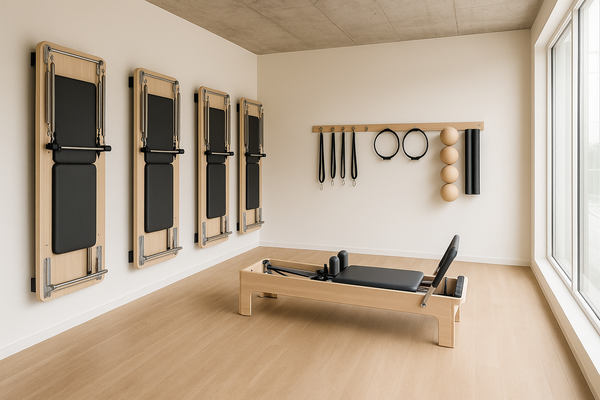
Pilates studio interior design should calm clients, improve flow, and strengthen brand through smart layout, layered lighting, quiet aesthetics, sensory comfort, and future-ready features that keep the space functional and memorable. Neutral tones like whites, warm beiges, soft grays, and light pastels are the most widely recommended for Pilates studio interiors because they promote calm and allow clients to focus. In a market where only 9.4% of studios achieve 20%+ margins, design becomes a tool to justify premium pricing and reduce client acquisition costs through word-of-mouth and social shareability.
Geographic Expansion Patterns: U.S. Market Saturation and International Entrants
CorePlus has been turning heads in 2025 and 2026 with its strategic expansion from Australia into the U.S. wellness market, now operating in 30+ locations globally including its first U.S. studio in Arizona. JETSET Pilates concentrated its 24 new 2025 studios across Texas, Florida, Georgia, North Carolina, New Jersey, Massachusetts, Colorado, and Washington, D.C., targeting metropolitan and high-growth suburban markets. STRONG Pilates has pursued multi-site franchise agreements in Dallas, Austin, Los Angeles County, Orange County, San Diego, New Jersey, and Massachusetts, clustering locations to achieve local brand density and operational efficiencies.
This clustering strategy reflects a shift from scattershot national expansion to regional dominance, enabling franchisees to share instructor pools, centralize marketing spend, and negotiate better lease terms. However, it also intensifies local competition and accelerates market saturation, particularly in Texas, Florida, and coastal metro areas where multiple franchise brands now compete head-to-head.
What This Means for Studio Operators
Editorial analysis, not reported fact:
If you are evaluating a franchise investment in 2026, the unit economics data from JETSET Pilates ($1.13 million AUV) and Studio Pilates International ($888,774 AUV) provide benchmarks to pressure-test franchisor projections. Ask whether your territory has already been saturated by other franchise brands, and whether the franchisor can demonstrate proprietary equipment, training systems, or design standards that justify premium pricing in your local market.
If you operate an independent studio, the 22% growth rate among agile independents in 2024 suggests there is still room to compete on flexibility, community, and specialized programming that franchises cannot easily replicate. However, the 0.2% studio count growth and 0.8% revenue decline in 2026 mean you must fight harder for every client and every dollar. Consider whether your interior design, instructor training, and class programming are differentiated enough to justify premium pricing and reduce reliance on discounting.
If you are planning a new studio opening, the multimillion-dollar Reforming Pilates flagship in NYC and the proprietary equipment strategies of Pilates Addiction and STRONG Pilates demonstrate that design and equipment exclusivity are no longer nice-to-haves. They are competitive necessities in a market where only 9.4% of studios achieve 20%+ margins. Budget for upfront investment in interiors and equipment that will support premium pricing and word-of-mouth marketing from day one.
Sources & Further Reading
- Pilates Addiction franchise expansion and unit economics data from Franchise Dictionary Magazine, covering territory awards, AUV benchmarks, and market saturation trends.
- The Pilates Business industry news archive, providing ongoing coverage of franchise growth, design trends, and profitability analysis.
Editorial coverage of publicly reported industry developments. The Pilates Business has no commercial relationship with any companies named.