Classical vs. Contemporary Pilates: The 2026 Legitimacy Crisis
Lineage, spine position, and equipment authenticity define a growing divide among US Pilates instructors. With no regulatory body, the debate reshapes hiring, pricing, and studio identity.

Key Takeaways
- Classical Pilates lineage traces directly to Joseph Pilates through first-generation teachers known as the Elders (Romana Kryzanowska, Kathy Grant, Ron Fletcher, and others), creating a 3-4 generation chain that classical instructors position as a legitimacy marker in an unregulated market.
- The spine position debate defines the divide: classical studios typically teach a "flat back" or posterior pelvic tilt during mat work, while contemporary Pilates emphasizes neutral spine to preserve natural lumbar curvature and align with current exercise science.
- Classical certification requirements from programs like Power Pilates or Classical Pilates USA involve at least 600 hours of training over 7-12 months with 18-22 hours of weekly studio work, compared to widely varying contemporary program standards.
- Equipment authenticity has become a market differentiator: classical studios invest in Gratz apparatus built to Joseph Pilates' original 1920s-1940s specifications, while contemporary studios use reformers modified for broader body types and expanded exercise repertoires.
- No federal or national regulatory body governs Pilates certification or studio standards in the United States as of 2026, leaving the classical vs. contemporary question as an unresolved legitimacy crisis affecting hiring, pricing, and brand positioning.
- Knowledge gaps between teaching philosophies are widening: some contemporary instructors lack familiarity with Elder lineage history, while classical purists resist integrating exercises or modifications developed after Joseph Pilates' 1967 death.
Why Lineage Became Currency in an Unregulated Market
The classical vs. contemporary Pilates debate centers on a fundamental question: is Joseph Pilates' original method a complete system to be preserved, or a foundation to be developed using advances in physical therapy and exercise science? Without universal exercise guidelines or oversight from any federal, state, or national Pilates organization, this philosophical split has real operational consequences for US studios and instructors in 2026.
Power Pilates and similar classical programs position lineage as a legitimacy marker. Students and graduates stand just 3-4 generations from Joseph Pilates himself, having learned from instructors who trained under the Elders: Romana Kryzanowska, Kathy Grant, Ron Fletcher, Carola Trier, Bruce King, and Mary Bowen. These first-generation teachers absorbed the work through years of direct study with Joseph and Clara Pilates at the original New York studio.
U.S. Pilates LLC, successor to the United States Pilates Association, offers The Classical Pilates USA Teacher Certification Program based entirely on the original work of Joseph Pilates and Romana Kryzanowska, certifying instructors in classical methodology since 2005. This documented chain of transmission distinguishes classical Pilates from other movement education bearing the Pilates name.
The 600-Hour Training Gap and What It Signals
A comprehensive classical Pilates program taught by first- or second-generation instructors typically consists of at least 600 hours of training. Most programs last 7-12 months, during which participants engage in 18-22 hours of studio training each week. This investment creates a sharp contrast with contemporary certification pathways, which vary widely in rigor and duration across providers.
The training disparity feeds classical instructors' concerns about quality control. The world of contemporary Pilates is vast, with significant variation in both training and ability among certified teachers. One classical instructor recounted an encounter: "When someone asked a contemporary Pilates instructor about classical pilates and the history of the elders and she didn't know what I was talking about." This knowledge gap signals a real generational and pedagogical divide affecting how studios vet candidates and justify premium pricing.
Flat Back vs. Neutral Spine: The Biomechanics Flashpoint
The biggest technical debate in classical vs. contemporary Pilates centers on spinal positioning. Classical Pilates often utilizes a "flat back" or posterior pelvic tilt during mat work, following Joseph Pilates' original cueing. Contemporary Pilates generally teaches a "neutral spine," respecting the natural curvature of the lower back to absorb shock and improve functional movement in daily life.
Classical instructors view Pilates as a complete, interconnected system where each exercise builds upon others in a specific sequence. Contemporary Pilates is more flexible, allowing modifications of classical exercises to accommodate individual needs and integrate new equipment or exercises not originally part of Joseph Pilates' repertoire. These modifications aim to enhance accessibility and effectiveness for a diverse population, particularly clients recovering from surgery or managing chronic conditions.
Some instructors teach both approaches and find that contemporary Pilates is more suitable for students recovering after operations because of the modifications and new exercises "borrowed" from other fitness disciplines or invented by physical therapists. Yet classical practitioners counter that their method has internal flexibility: "In private instruction sessions, we maintain authentic classical Pilates integrity while being able to adapt to each person's individual needs."
Equipment Wars: Gratz Apparatus vs. Modern Reformers
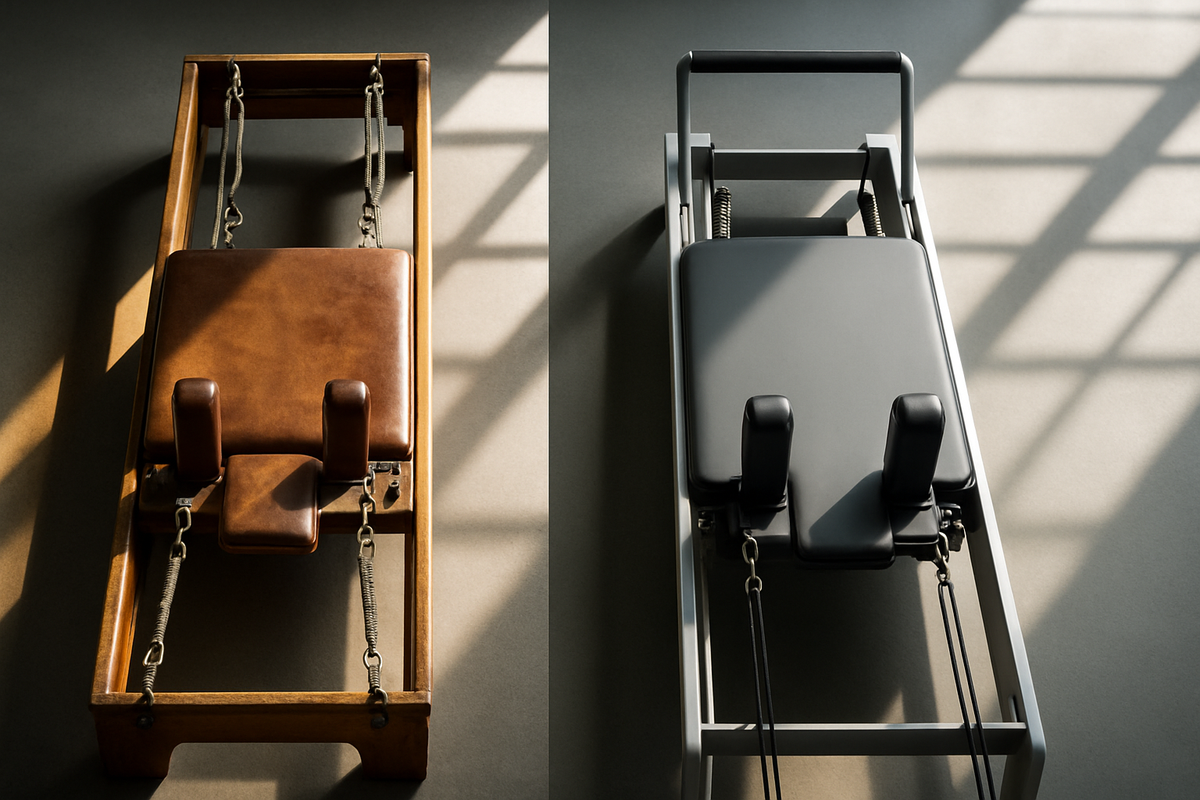
Classical studios position Gratz apparatus as the gold standard in Pilates equipment. Each reformer is meticulously crafted to Joseph Pilates' original specifications from his New York studio era, honoring precise dimensions, correct spring tensions, and original materials. The Classical Pilates reformer stays true to what Joseph Pilates used, designed for purists who wish to practice Pilates as originally intended.
Contemporary reformers have evolved from the classical design to accommodate modern fitness research, material advancements, and biomechanics. They feature various modifications to cater to a broader range of exercises and body types. This equipment choice signals teaching philosophy and becomes a tangible market differentiator: classical studios can justify higher session rates by pointing to authentic apparatus, while contemporary studios emphasize accessibility and injury accommodation.
The Authenticity Paradox: Historical vs. Applied
Authenticity in Pilates refers to lineage, not quality. Classical Pilates preserves original sequences, equipment use, and teaching methods, appealing to purists. Contemporary Pilates maintains foundational principles but adapts exercises and cueing using current science. Both are authentic within their intended application: one historical, one applied.
The irony is that both camps claim fidelity to Joseph Pilates' vision. Classical practitioners ask: "Why fix an already perfectly good system?" Contemporary advocates respond that advances in kinesiology and rehabilitation science honor the spirit of innovation Pilates himself demonstrated. One instructor noted: "Some believe that having a classical foundation is a good start but one should always be willing to evolve. Of course there are others who would vehemently disagree with that statement."
Client Confusion and Instructor Superiority Complexes
The debate spills into client-facing marketing and social media. A TikTok post claiming "Pilates can only be taught by instructors who have gone through a thorough certification process and learned classical moves as a foundation" received 2,981 likes, illustrating the appeal of lineage-based gatekeeping. But pushback is growing: "We all have preferences but superiority complexes have no place in fitness/wellness and add no value to the end client we serve."
Clients face a knowledge asymmetry. You could have 10 Pilates instructors in one room and they would probably never agree on what is the right way to teach. Without regulatory guidance, consumers rely on studio marketing, instructor confidence, and anecdotal recommendations to navigate claims of authenticity and effectiveness.
What This Means for Studio Operators
Editorial analysis — not reported fact:
Studio owners in 2026 cannot avoid taking a side in this debate, even if implicitly. Your equipment choice, instructor hiring criteria, class descriptions, and pricing all signal where you fall on the classical-contemporary spectrum. If you invest in Gratz apparatus and hire instructors with 600-hour classical certifications, you are competing on heritage and purity. If you stock contemporary reformers and emphasize modifications for diverse populations, you are competing on accessibility and science-backed adaptation.
The operational stakes are real. Classical positioning may justify higher session rates and attract clients seeking "authentic" lineage, but it limits your instructor talent pool to a smaller, more expensive cohort. Contemporary positioning broadens your hiring options and appeals to rehab and medical referral channels, but you face steeper competition from budget reformer franchises and hybrid fitness concepts.
Because no federal, state, or national Pilates organization enforces standards, your brand clarity matters more than ever. Spell out your teaching philosophy on your website. Define what "certified" means in your context. If you teach both approaches, explain when and why you use each. Clients cannot navigate this legitimacy crisis on their own; transparency about your methodology is a competitive advantage, not a vulnerability.
Sources & Further Reading
- Power Pilates — Classical Pilates certification program emphasizing 3-4 generation lineage from Joseph Pilates
- Classical Pilates USA (U.S. Pilates LLC) — Teacher certification program based on Joseph Pilates and Romana Kryzanowska methodology, certifying since 2005
- Gratz Pilates — Manufacturer of apparatus built to Joseph Pilates' original specifications
Editorial coverage of publicly reported industry developments. The Pilates Business has no commercial relationship with any companies named.