How to Extend the Life of Your Studio's Reformers
Commercial reformers last 10+ years with proper maintenance. Budget $150-$250 per reformer annually and follow daily, weekly, and monthly protocols to prevent costly failures.

Key Takeaways
- Reformer lifespan: A commercial Pilates reformer will last more than ten years with proper maintenance, but usage intensity determines actual component replacement schedules—springs in high-volume studios need replacement every 6 to 8 months versus 2 to 3 years for private studios.
- Annual maintenance budget: Plan for $150 to $250 per reformer annually, or $1,200 to $2,000 for an eight-machine studio—predictable operating costs that prevent catastrophic equipment failures and client experience degradation.
- Spring replacement drives costs: Springs lose 15 to 20% tension after 500 hours and cost $150 to $250 per set to replace; studios running 8 to 10 classes daily per reformer should budget for replacement every 6 to 8 months.
- Daily cleaning delivers highest ROI: Wiping down all surfaces with gentle, alcohol-free cleaner after every session takes under two minutes per machine and is the single most effective habit for extending reformer lifespan and preventing upholstery degradation.
- Deferred maintenance costs more: One lost client at $200 per month costs more over time than replacing every spring on a reformer for two years—reactive maintenance appears cheaper in year one but compounds into higher total costs and client churn by year five.
- Strength Pilates accelerates wear: Studios blending reformer work with strength blocks experience heavier spring loads and increased carriage wear, requiring more frequent component replacement than traditional programming.
Why Studios Ignore Maintenance Until It Costs Them
Reformers represent one of the largest capital investments in a Pilates studio. Commercial-grade reformers typically cost between $3,000 and $6,000 each, yet many operators treat maintenance as discretionary rather than essential. The hidden cost of this approach is client churn: degraded equipment creates a substandard experience that drives members to competitors offering newer, better-maintained apparatus.
The economics are stark. A single lost client paying $200 per month represents $2,400 in annual revenue—far more than the cost of replacing springs on multiple reformers for two years. Yet studios routinely defer component replacement until equipment fails during class, creating both safety risks and operational downtime. The reactive strategy appears cheapest in year one but costs the most over five years when accounting for client churn from degraded equipment.
The pressure is intensifying. Studios offering strength-focused Pilates formats are putting equipment under heavier stress than traditional programming. Heavier spring loads and fusion formats that blend reformer work with resistance training accelerate wear on carriages, springs, and rollers. As class prices rise—up roughly 6% year over year in 2026—clients expect equipment quality that matches premium pricing.
The Complete Maintenance Protocol: Daily, Weekly, Monthly
Effective reformer maintenance follows a tiered schedule that prioritizes high-impact, low-effort tasks. Daily maintenance protocols form the foundation of equipment longevity.
Daily: After Every Session
Wipe down all surfaces with a gentle, non-toxic, alcohol-free cleaner. This takes under two minutes per machine and is the single highest-return habit in reformer maintenance. Upholstery that receives post-session cleaning and remains out of direct sunlight will typically last three to five years in a studio environment. Upholstery that is never cleaned or exposed to UV light from windows can crack within a year.
Weekly: Visual Inspections
Inspect springs for kinks or gaps each week. If damage is found, discard and replace the spring immediately. Similarly, inspect ropes for fraying and replace them immediately if found. These components represent the biggest safety and failure risk in group operations.
Monthly: Mechanical Checks
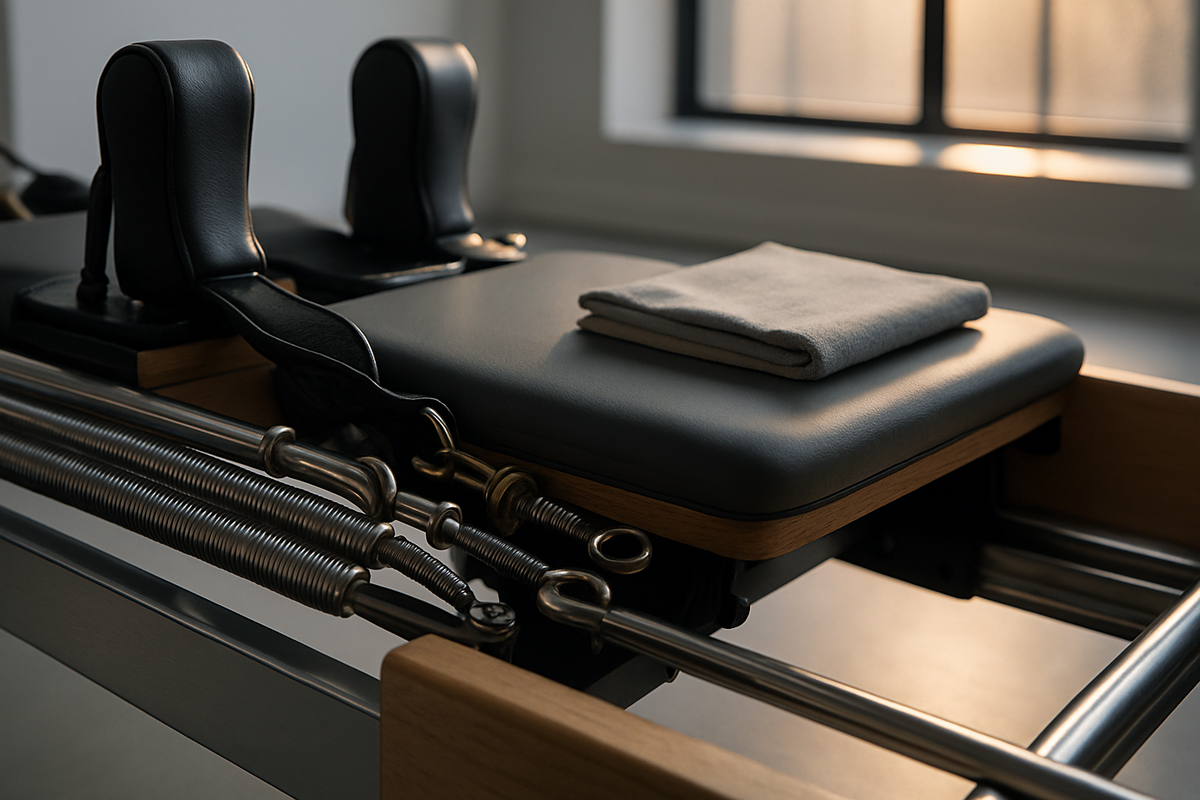
Check and tighten any loose nuts, bolts, or screws on your equipment. Wipe down the reformer's carriage tracks and wheels to keep them free from obstructions and buildup. Apply a silicone-based lubricant to the wheels and tracks every few months to reduce friction and ensure the carriage glides smoothly. Avoid oil-based lubricants, as these attract dust and dirt.
Annual: Deep Inspection and Component Replacement
Conduct a thorough inspection and deep-clean. For safety and performance, replace all springs after two years, regardless of whether they are showing signs of wear. Studios running higher class volumes should schedule professional servicing every six months to catch wear and tear before it becomes a safety hazard.
Component Replacement Economics by Class Volume
Replacement timing varies sharply by usage intensity. Springs lose 15 to 20% tension after 500 hours, but what that means in calendar time depends entirely on class throughput.
For a reformer used in 8 to 10 classes per day in a high-volume commercial studio, springs should be replaced every 6 to 8 months. Moderate-use reformers at 4 to 5 classes a day can go 12 to 18 months between spring changes. Low-volume private studios may only need spring replacement every 2 to 3 years. Each replacement costs $150 to $250 per set.
Other critical wear components follow different schedules. Ropes and straps require replacement every 1 to 2 years at $40 to $80 per set. Wheels last 3 to 5 years and cost $60 to $120 per set. Upholstery replacement runs $200 to $400+ per reformer and is needed every 3 to 5 years, or $3,200 to $7,200 total for reupholstering eight reformers.
Understanding total cost of ownership means budgeting for these cycles from day one. Budget $150 to $250 per reformer annually—for a studio with 8 machines, that's $1,200 to $2,000 per year, a predictable operating cost that prevents major equipment failures.
Making Maintenance Systematic: Staff Assignments and Checklists
Consistency beats technical skill. The most effective maintenance programs assign clear ownership and use visual tools. Post a laminated checklist next to each piece of equipment and clearly define who checks what and when: the trainer performs the daily visual inspection of springs and cables before the first class, and a designated team member handles the monthly inspection.
Some studios invest in professional training. Online reformer maintenance training from certified Pilates equipment technicians runs $2,500 per person or $3,850 per household for two people. For multi-location operators or studios with large fleets, this investment builds in-house expertise that reduces reliance on third-party service calls.
Documentation also matters for liability and insurance purposes. Maintaining maintenance documentation protocols creates a paper trail that demonstrates operational diligence and can reduce insurance premiums while strengthening claims if equipment-related incidents occur.
The Commercial vs. Home Reformer Mistake
Using a home reformer at studio volume voids the warranty and accelerates wear—a common and costly mistake among new studio operators trying to minimize startup costs. A commercial frame is built for 6 to 10 sessions a day, every day. A home reformer used that hard wears out quickly and voids its warranty, leaving operators without manufacturer support when components fail.
The initial price difference between home and commercial reformers is real, but the lifecycle economics favor commercial equipment for any studio running group classes. Equipment economics must account for usage intensity, not just purchase price. Environmental factors matter too: climate control for equipment longevity protects upholstery and prevents premature degradation from temperature swings and humidity.
What This Means for Studio Operators
Editorial analysis, not reported fact:
The maintenance practices that separate profitable studios from those bleeding cash on emergency repairs come down to systems, not heroics. A laminated checklist executed daily by whichever instructor opens the studio will outperform sporadic deep cleans performed quarterly by the owner. Assigning one team member to own monthly mechanical checks creates accountability without requiring technical expertise.
The math is unforgiving for studios deferring spring replacement to preserve short-term cash flow. At 8 to 10 classes per day, a reformer's springs hit 500 hours of use in roughly six to eight weeks. Running those springs for a full year means clients are training on equipment operating at 15 to 20% below spec for ten months—a degraded experience they notice even if they can't articulate why. The client who doesn't renew because "it just doesn't feel the same as the studio down the street" is responding to deferred maintenance you could have prevented for $200.
For studios embracing strength-focused programming or fusion formats, equipment budgets need recalibration. Heavier spring loads and higher carriage impact mean faster wear cycles. The same reformer that might go 18 months between spring replacements in a traditional program may need servicing every 8 months under athletic protocols. Budget accordingly or risk equipment failure during your highest-revenue class blocks.
Finally, treat professional servicing as insurance, not expense. Six-month professional inspections catch compound failures before they cascade—a worn wheel that damages the carriage track, a frayed rope that snaps mid-session. The cost of professional servicing is a fraction of the cost of replacing a carriage or managing a client injury claim.
Sources & Further Reading
- Align Pilates: The Complete Reformer Maintenance Checklist for Pilates Studios, daily and weekly inspection protocols
- Megacore Pilates: Pilates Reformer Spring Replacement Guide, spring wear timing and replacement procedures
- bsport: Equipment Costs and Class Size for Reformer Pilates Studios, annual maintenance budgets and reactive vs. preventive cost analysis
- BenchK: Open Pilates Studio Equipment Budget, upholstery replacement costs and fleet budgeting
- Recov Athlete: How Much Does a Commercial Pilates Reformer Cost? 2026 Pricing Guide, commercial reformer pricing and investment context
- Pilates Supply Co: The True Cost of Friction – A Maintenance Guide for Reformer Pilates Studio Owners, component replacement schedules and costs
- BASI Systems: Pilates Reformer Maintenance – Daily, Weekly, Monthly, tiered maintenance protocol
- NordicTrack: Commercial Pilates Reformer Studio, commercial vs. home reformer usage and warranty issues
- Megacore Pilates: Strength Pilates Reformer Guide 2026, equipment wear in strength-focused programming
Editorial coverage of publicly reported industry developments. The Pilates Business has no commercial relationship with any companies named.