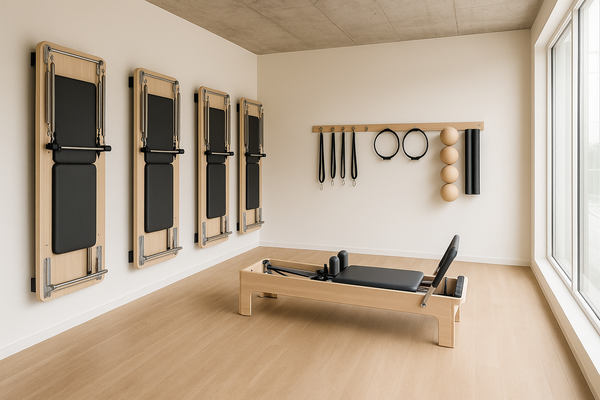
Design-Forward Pilates Studios Compete as Market Saturates
JETSET opened 24 studios in 2025, Bodybar targets 70+ in 2026, and Pilates Addiction plans 100+ locations. How design, small-group formats, and business models drive differentiation.

Key Takeaways
- Franchise expansion accelerates in 2026: JETSET Pilates opened 24 studios in 2025 and now has 270+ locations open or in development, while Bodybar Pilates targets 70+ new openings this year and Pilates Addiction plans over 100 locations.
- Unit economics remain strong despite saturation: Studio Pilates International reports an average unit volume of $888,774 while JETSET Pilates achieved approximately $1.13 million in 2025, though typical startup costs range from $150,000 to $350,000 and most studios require six to nine months to reach cash-flow positivity.
- Design differentiation emerges as competitive strategy: Studios from The Daily Pilates' calming neutral palette to Heartcore's intentionally dark, immersive environments use aesthetics to justify premium pricing and attract specific clientele, with design now recognized as an underrated growth lever.
- Small-group formats replace large classes: Studios increasingly cap classes at 6 to 8 participants to deliver personalized attention at rates higher than traditional group classes but more accessible than private sessions, creating margin expansion opportunities.
- Format diversification allows multiple studios per market: At least seven Pilates or Pilates-adjacent studios opened in Austin since fall 2025 alone, reflecting how classical lineage-based instruction, athletic reformer workouts, and Lagree-style strength training serve distinct audiences without direct competition.
- Private equity consolidates ownership: Eagle Merchant Partners-backed Aligned Fitness now operates 55 Club Pilates locations after acquiring 19 studios through add-on deals in 2025-2026, signaling portfolio-scale management replacing single-location ownership.
Why Design and Business Model Innovation Define the 2026 Studio Landscape
The Pilates studio market entered a critical inflection point in 2026. After years of explosive growth, with the percentage of US studios offering Pilates climbing from 17% in 2021 to 45% in 2025, franchise expansion continues at breakneck pace while operators increasingly compete on aesthetics, class format, and founder storytelling rather than proximity alone.
JETSET Pilates opened 24 new studios in 2025, bringing its total footprint to over 270 studios open or in development. Bodybar Pilates is targeting over 70 new studio openings in 2026, with 40 slated for Q3 and Q4. Pilates Addiction, operating under Sequel Brands founded by Xponential Fitness founder Anthony Geisler, plans to open over 100 locations in 2026 alone. This expansion wave collides with rising market saturation, forcing studios to differentiate beyond location and equipment.
Strong Unit Economics Fuel Franchisee Demand Despite Startup Realities
Studio Pilates International reported a newly updated average unit volume of $888,774 for its US studios, while JETSET Pilates reported a 2025 systemwide average unit volume of approximately $1.13 million. These figures signal the kind of unit economics that attract franchisee capital and private equity interest.
The path to profitability requires patience and capital reserves, however. According to the 2026 Pilates Trends Report from Mariana Tek, opening a Pilates studio in 2026 typically costs $150,000 to $350,000 for a standard boutique build, and most boutique Pilates studios do not reach cash-flow positivity in their first six to nine months. The strong AUV numbers demonstrate what is possible after the startup phase, but operators must plan for extended ramp-up periods.
Founder Stories and Engineered Business Models as Differentiation
Studio Pilates International founders Jade and Tanya Winter illustrate how intentional business model design drives scalability. Per the Studio Pilates expansion announcement, the founders spent more than two decades in the Pilates industry, starting as a single Brisbane studio working 70 to 80 hours weekly instructing private and semi-private classes before evolving into one of the largest Pilates franchises.
Their key insight reshaped the business model: the traditional semi-private model was not sustainable long-term because, as they observed, if two clients cancel, you lose the revenue for that class. They engineered a group-class-based scalable model that stabilized revenue and reduced schedule fragility. This kind of operational redesign, rather than simply replicating existing formats, creates franchise value.
New York Pilates founders Heather Andersen and Brion Isaacs represent a different differentiation path, according to industry coverage. Andersen focuses on anatomy and intelligent reformer sequencing while Isaacs brings a background in design, art, and music to the brand's identity, creating a studio experience that merges technical rigor with aesthetic curation. Figue Madera Pilates in Northridge and Topanga Village, California, similarly introduces an elevated approach to reformer Pilates through a studio experience blending design, community, and purposeful movement.
Design as Competitive Moat: From Calming Neutrals to Intentional Darkness
According to Mariana Tek's 2026 trends analysis, Pilates studios in 2026 are no longer just places to work out. The best studios are carefully designed experiences that communicate quality, attract the right clients, and support premium pricing, making design one of the most underrated growth levers for studio owners.
The Daily Pilates, a luxury reformer Pilates brand based in Atlanta that first opened in 2015, opened its first North Carolina location in Ballantyne in June 2026. The Daily contrasts sharply with the dark lighting, loud music, and party-like atmosphere often found at trendy reformer studios. Instead, the studio is designed to be a calming space where instructors do not wear microphones during class, there is no overhead lighting, and the interior uses a soft neutral palette.
Heartcore takes the opposite aesthetic approach but with equally intentional strategy. The brand has built a strong identity by going against the typical bright Pilates studio approach. Their studios are intentionally dark, immersive, and distraction-free, with low lighting that creates focus and reduces visual distractions. JETSET Pilates officially opened its new headquarters in Miami's Wynwood neighborhood, designed by Miami-based, globally recognized architecture firm Kobi Karp, further demonstrating how franchise brands deploy design as brand equity.
Emerging design trends identified in the Mariana Tek report include hybrid studios with streaming setups, touchless check-ins, sustainability practices such as LED lighting and reclaimed wood with energy-efficient HVAC, and wellness corners with recovery spaces or breathwork zones for client retention.
Small-Group Formats Replace Large Classes to Capture Margin and Personalization
Per the 2026 Pilates Trends Report, large group classes are out and small groups are in. Studios offering small group classes often cap participation at 6 to 8 participants, delivering more personal attention than large group classes while remaining more affordable than one-on-one training. This format allows studios to charge higher rates for exclusivity while improving instructor-to-client ratios.
The shift reflects both client preference for personalized coaching and studio economics. Small-group pricing generates higher per-class revenue than traditional group formats, while instructors can deliver more individualized cuing and correction. For operators managing tight labor costs, the small-group model optimizes revenue per instructor hour without sacrificing the community atmosphere that drives retention.
Market Saturation Meets Format Diversification in Major Metro Areas
According to industry reporting compiled by Mariana Tek, Pilates studios are opening across Austin at a noticeable clip, with at least seven Pilates and Pilates-adjacent venues opening or announcing plans to open since fall of 2025. This reflects growing interest in low-impact workouts that emphasize strength, mobility, and longevity.
Pilates no longer means just one thing. Today's studios range from classical, lineage-based instruction to athletic reformer workouts, mat Pilates alongside yoga, and Pilates-adjacent methods like Lagree that focus on strength. This diversification allows many studios to open at once without all competing for the same audience. A client seeking traditional Romana's Pilates lineage instruction will not necessarily overlap with the client seeking a high-intensity, music-driven reformer class in a dark studio, even if both studios sit within a two-mile radius.
Private Equity Consolidation Reshapes Ownership from Boutique to Portfolio Scale
Private equity capital is reshaping Pilates studio ownership from single-location boutiques into scaled, professionally managed portfolios. Eagle Merchant Partners-backed Aligned Fitness now operates 55 Club Pilates locations after acquiring 19 studios through add-on deals in 2025 and 2026. This portfolio consolidation introduces institutional management practices, centralized marketing, and economies of scale in purchasing and labor management, fundamentally altering competitive dynamics for independent operators.
What This Means for Studio Operators
Editorial analysis — not reported fact:
Studio operators entering or expanding in 2026 face a market where growth and saturation coexist. The unit economics remain attractive enough to fuel aggressive franchise expansion, but differentiation now determines whether a new studio captures market share or simply fragments an already crowded local market. Design is no longer optional or cosmetic. Whether you choose calming neutrals like The Daily or immersive darkness like Heartcore, your aesthetic must communicate a specific value proposition that justifies your pricing and attracts a defined client persona.
For franchisees evaluating which system to join, scrutinize not just the AUV figures but the business model architecture underneath. Studio Pilates International's pivot from semi-private to group reformer reflects the kind of revenue stabilization that protects against schedule volatility. Small-group formats offer margin expansion opportunities, but only if your local market supports the premium pricing required to offset lower class capacity.
Independent operators should recognize that format diversification creates opportunity. You do not need to compete head-to-head with the Club Pilates or JETSET franchise two blocks away if your instruction philosophy, class structure, or studio environment serves a distinct clientele. Classical purists, prehab-focused clinical practitioners, and athletic performance seekers represent separate markets even within a single metro area.
Finally, expect continued private equity activity. Multi-unit franchise portfolios under institutional ownership will bring operational sophistication and capital access that single-location independents cannot match. If you operate profitably and own multiple locations, you may receive acquisition interest. If you remain independent, you will need to compete on the dimensions PE-backed competitors cannot easily replicate: instructor relationships, community depth, and localized programming that responds to your specific clientele faster than a 55-location portfolio can.
Sources & Further Reading
- JETSET Pilates 2025 expansion announcement — franchise growth milestones, average unit volume, and new Miami headquarters designed by Kobi Karp
- Mariana Tek 2026 Pilates Trends Report — industry growth statistics, design trends, small-group format shift, startup costs, private equity activity, and Austin market saturation data
- Bodybar Pilates expansion plans reported by Athletech News — 70+ new studio openings targeted for 2026
- Pilates Addiction franchise growth reported by Athletech News — 100+ locations planned for 2026 under Sequel Brands
- Studio Pilates International US expansion announcement — average unit volume of $888,774, founder business model evolution from semi-private to group reformer
Editorial coverage of publicly reported industry developments. The Pilates Business has no commercial relationship with any companies named.