Group Reformer Layouts: Maximizing Space Without Overcrowding
Reformer spacing standards, layout configurations, and equipment choices that determine studio capacity, teaching quality, and revenue per square foot in 2026.

Key Takeaways
- Reformer spacing standards: Group class studios require a minimum of 48 inches between reformer edges, while private session studios can use 36 inches, with each reformer occupying approximately 50 square feet including movement space.
- Layout configuration impacts capacity: Parallel row arrangements fit 6 reformers in roughly 400 square feet, while semicircle layouts require approximately 600 square feet for the same capacity, making configuration choice a direct revenue decision.
- Demand surge drives urgency: Life Time's reformer class became the most waitlisted class in company history, and ClassPass reported a 66% increase in Pilates reservations from 2024 to 2025, making capacity optimization critical for capturing current market demand.
- Equipment selection changes the math: Folding and stackable reformers allow studios to expand from 10-person to 12- or 14-person classes in the same footprint by storing equipment vertically between sessions.
- Hidden space costs are substantial: Front-of-house operations require 60 to 100 square feet, and poor layout planning forced one Barcelona studio to reduce capacity from 12 to 9 reformers, costing $7,800 in monthly revenue.
The Cost of Getting Layout Wrong
A Barcelona boutique studio signed a lease expecting to accommodate 12 reformers but discovered too late that machines placed close to walls made safe mounting impossible. The studio was forced to reduce capacity to 9 machines, losing $7,800 in monthly revenue. This calculation error represents the most common and most expensive mistake in reformer studio design: treating floor space as a simple division problem rather than a three-dimensional teaching environment.
Layout errors compound over time. While paper plans may show that reformers technically fit within a room's dimensions, they rarely account for instructor movement patterns, client entry and exit paths, or the physical reality of cueing corrections during a flowing class. Industry spacing standards recommend a minimum of 48 inches from reformer edge to reformer edge for group classes, with private studios able to compress to 36 inches. The difference reflects teaching style: group instructors must circulate and offer hands-on adjustments, while private sessions allow static positioning.
Three Core Layout Configurations and Their Trade-Offs
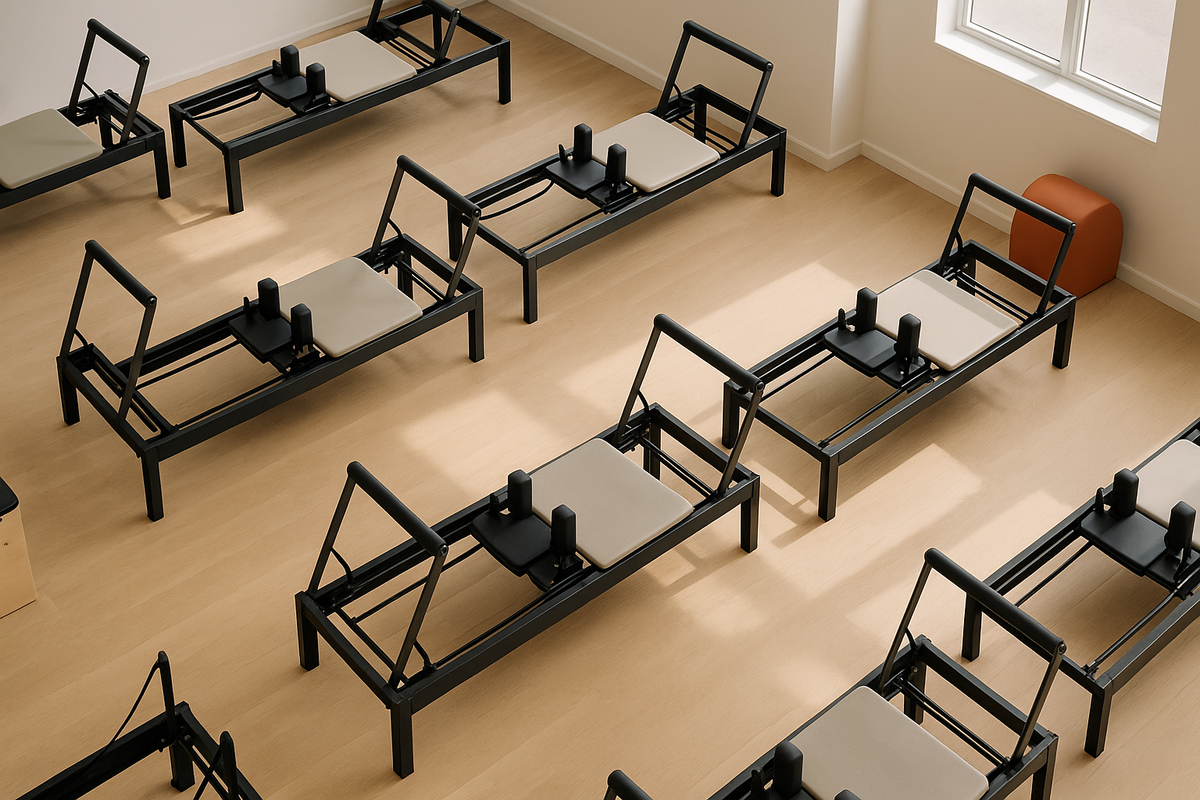
Parallel rows represent the most common group class arrangement, with reformers facing the same direction in neat lines. This configuration maximizes space efficiency and allows instructors to demonstrate at the front while maintaining sight lines across all clients. A 6-reformer parallel setup requires approximately 400 square feet, making it the default choice for studios under 1,000 square feet.
Concentric or semicircle layouts arrange reformers in a curve around the instructor station, allowing 360-degree observation without excessive movement. This setup suits hands-on teaching styles and creates a more intimate class atmosphere. However, the same 6-reformer capacity requires roughly 600 square feet in a semicircle configuration, a 50% increase over parallel rows. Studios choosing this layout are explicitly trading rent cost for teaching quality and client experience.
The "alley configuration," with reformers facing each other across a narrow walkway, should be avoided despite its apparent efficiency. Clients make eye contact during exercises when lying down, instructors must squeeze between machines to offer corrections, and the cramped environment signals budget operation rather than premium service. This layout appears frequently in cost-driven conversions of retail space but consistently degrades both teaching effectiveness and client retention.
Equipment Innovation Changes the Capacity Equation
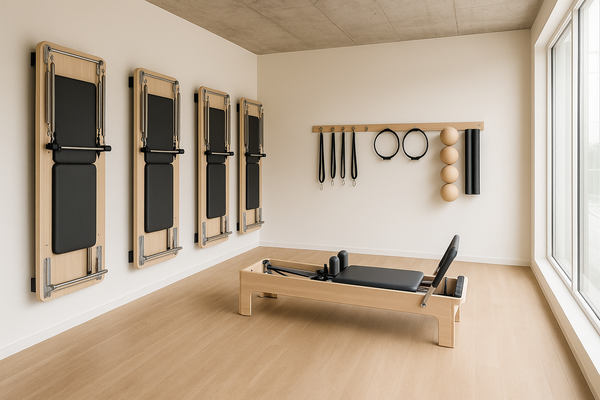
Folding and stackable reformers are designed for maximum portability and space-saving, allowing studios to reconfigure between class formats or expand capacity during peak hours. A studio running five 10-person group classes daily could expand to 12 or 14 participants by replacing standard reformers with stackable models, capturing waitlist demand without increasing rent.
This equipment category creates new business models for smaller footprints. A 500-square-foot space that traditionally accommodates 6 to 8 fixed reformers can store 10 to 12 folding units vertically between sessions, then deploy only the number needed for each class size. The capital investment in specialized equipment pays back through flexible scheduling: morning privates, midday small groups, and evening large-format classes all operate from the same physical footprint.
The Sweet Spot for Independent Studios
A 1,000 square foot boutique studio is ideal for 6 reformers, while a 1,800 square foot facility accommodates 8 or more machines. These benchmarks assume proper aisle width (minimum 3 feet for instructor circulation), front-of-house space (60 to 100 square feet for check-in and retail), and client comfort during peak arrival times.
The 10-reformer configuration emerges as optimal for most independent operators: it supports full 8-person group classes while maintaining 2 machines available for private sessions or consultations. Industry guidelines suggest 21 square feet per participant for yoga and Pilates spaces, but reformer work requires closer to 50 square feet per machine when accounting for movement zones and teaching access.
Client-to-instructor ratios typically range from 5 to 8 clients per instructor in group classes, balancing personalized attention against revenue per session. Studios exceeding this ratio see faster skill progression among clients but generate lower absolute revenue; those pushing toward 10 or 12 clients per instructor capture more tuition but risk safety concerns and teaching quality degradation.
Demand Context and Competitive Pressure in 2026
Life Time reported that its CTR reformer class became the most waitlisted class in company history, driving the decision to include Pilates studios in each of its 12 to 14 planned new locations opening in 2026. This institutional validation of reformer demand creates immediate competitive pressure on independent studios: clients now expect availability and capacity comparable to large fitness clubs.
ClassPass data showed Pilates was its most-booked workout for the third consecutive year in 2025, with a 66% increase in overall reservations from 2024. Reformer classes specifically face higher waitlist demand compared to mat classes, creating a business tension: popular instructors become booked solid with huge waitlists, a sign of professional success that paradoxically becomes unsustainable as instructors lack capacity to handle student volume.
When scouting competitors, operators should note which studios maintain persistent waitlists for reformer classes. This signals both market demand and capacity constraints, indicating expansion opportunity for new entrants or established studios with available square footage.
Revenue Per Square Foot Versus Teaching Quality
A 20-reformer studio operating at 60% utilization generates higher absolute revenue than a lean 8-reformer operation at 90% utilization, but fixed costs (rent, utilities, insurance) mean the larger facility often produces lower margins per machine. The calculation shifts further when accounting for instructor burnout: teaching back-to-back 12-person classes in a crowded layout accelerates turnover and reduces hands-on correction quality.
Front-of-house space represents a hidden but critical allocation. Studios that skip dedicated reception areas to maximize reformer count end up with clients crowding the studio floor before class, disrupting sessions in progress. The 60 to 100 square feet dedicated to check-in, a retail shelf, and pre-class staging signals professionalism that drives early membership conversion, particularly among clients comparison shopping between studios.
Scheduling platforms increasingly offer smart waitlist fills and dynamic class-capacity optimization, accounting for cleaning and setup breaks between sessions. These tools help studios operate at higher utilization without instructor burnout, but they require accurate capacity limits based on physical layout rather than theoretical maximums.
What This Means for Studio Operators
Editorial analysis, not reported fact: The current demand surge creates pressure to maximize reformer count, but layout decisions made under time pressure in 2026 will constrain operations for the length of a lease term, typically three to five years. Operators should prioritize teaching quality and instructor sustainability over theoretical maximum capacity, particularly given the documented waitlist demand that allows studios to run full classes at smaller sizes.
The business case for folding or stackable reformers strengthens considerably for studios under 1,200 square feet or those operating in mixed-use spaces where reformers must be stored between sessions. The capital premium (typically 20% to 40% over standard reformers) pays back within 18 to 24 months if the flexibility enables even two additional clients per peak class.
Operators signing new leases should budget for professional layout consultation before committing to space. The Barcelona studio's $7,800 monthly loss from a 3-reformer capacity reduction represents $93,600 annually, far exceeding the cost of expert planning. When evaluating competitive square footage, note that larger spaces operated at lower utilization often indicate layout inefficiency rather than market weakness, suggesting opportunity for well-designed smaller footprints.
Sources & Further Reading
- Life Time announces Pilates expansion plans, corporate press release detailing reformer class waitlist demand and 2026 facility plans
- Pilates industry statistics and ClassPass booking trends, third-party analysis of reservation data and market growth
- Pilates reformer dimensions and space requirements, technical specifications and spacing standards for studio layout
- Three types of studio reformers, equipment manufacturer guide to folding, stackable, and standard reformer options
- How many reformers per studio, capacity planning benchmarks for different square footage scenarios
- How to calculate gym space requirements, fitness industry spatial planning guidelines
Editorial coverage of publicly reported industry developments. The Pilates Business has no commercial relationship with any companies named.