Pilates Studio Spotlights: Design, Franchises & Models
Franchise brands sign 200+ territories, Miami boutiques turn design into competitive moats, and three revenue models shape 2026 studio strategy.


Key Takeaways
- Franchise expansion is accelerating: Pilates Addiction sold over 200 territories since launching in June 2025, JetSet Pilates opened 24 studios in 2025 alone and signed over 200 franchise agreements, and Studio Pilates International plans 300 US locations over six years.
- Design-as-brand differentiates luxury studios: Miami boutiques like Beau Monde and 727 position design, curated music, and integrated recovery amenities (infrared saunas, cold plunge) as competitive moats in high-end markets.
- Pilates reservations surged 66% on ClassPass between 2024 and 2025, making it the most-booked workout for the third consecutive year and signaling sustained post-pandemic demand for low-impact, high-intensity movement.
- Three revenue architectures dominate: private-session models for small high-income footprints, high-volume group reformer classes requiring 70%+ occupancy, and hybrid boutiques blending both to diversify income streams.
- Startup capital ranges from $385,000 to $870,000, with mature Club Pilates locations averaging $950,000–$1 million in annual revenue according to franchise disclosure documents.
- Investor capital is flooding franchise groups: Fortress Investment Group committed $72 million to Riser Fitness for expansion including 65+ Mexico studios, while Eagle Merchant Partners funded Aligned Fitness for Southeastern and Mid-Atlantic growth.
Why Pilates Studio Strategy Matters in 2026
The US Pilates market is no longer a monolith. Studios are differentiating through design-led branding, aggressive franchise expansion, and specialized programming as Pilates reservations on ClassPass jumped 66% between 2024 and 2025, cementing the modality as the most-booked workout for three consecutive years. This sustained demand has attracted private equity, spawned design-first boutiques in Miami and coastal markets, and driven franchise brands to sign hundreds of territory agreements in under a year.
The question for studio operators in 2026 is not whether Pilates will grow, but which business model and positioning strategy will capture that growth profitably. From equity-backed franchise rollouts to recovery-integrated luxury boutiques, the industry now offers a fragmented playbook worth examining in detail.
Franchise Brands Racing to 200+ Locations
Pilates Addiction, part of Anthony Geisler's Sequel Brands portfolio, sold over 200 franchise territories across the US despite launching its franchise program only in June 2025, according to recent industry reports. The brand distinguishes itself with a black-and-gold color scheme and proprietary WundaFormer machines, and plans to operate over 100 open studios by the end of 2026.
JetSet Pilates, founded in 2010 by former marketing executive Tamara Galinsky, has signed over 200 franchise agreements and opened 24 new studios in 2025 alone across Texas, Florida, Georgia, North Carolina, New Jersey, Massachusetts, Colorado, and Washington, D.C. The South Florida-based brand focused on premium neighborhoods and strong real estate fundamentals, and in 2025 opened a new Miami Wynwood headquarters designed by globally recognized architecture firm Kobi Karp. The facility houses JetSet's Instructor Training Academy and serves as a centralized hub for the brand's expanding network.
Studio Pilates International, founded in Brisbane in 2002, currently operates 120+ studios globally with 16 US locations open in New York, Kentucky, Minnesota, Colorado, North Carolina, Idaho, New Jersey, Tennessee, and California. The brand has 15 additional US studios scheduled to open during 2025 and plans 300 more domestic locations over the next six years.
Private equity and franchise groups are accelerating expansion. Riser Fitness, a franchisee group led by former Club Pilates president Mike Gray, received $72 million from Fortress Investment Group to fuel growth, including plans to open at least 65 studios in Mexico over the next decade. Eagle Merchant Partners took a stake in Aligned Fitness to expand Club Pilates locations across the Southeastern and Mid-Atlantic regions.
Design-Led Boutiques Turning Aesthetics into Competitive Advantage
In Miami, a city that has repositioned itself around infrared saunas and adaptogenic wellness, three studios are demonstrating how design can function as brand positioning. These are not neighborhood reformer rooms but design destinations where aesthetic calibration rivals spring tension, and membership signals joining a discerning club.
Crystal Behar's South Beach studio Beau Monde choreographs reformer classes to expertly curated playlists, transforming movement into rhythmic meditation. Custom hybrid reformers were designed specifically for this methodology, where slow, controlled repetitions sync with musical phrasing. The studio's soft neutrals, signature arched mirrors, and European spa sensibility photograph like a wellness editorial spread, intentionally positioning Beau Monde at the luxury end of Miami's Pilates spectrum.
727 operates as a full-service wellness hub offering reformer Pilates, Wunda Chair, mat Pilates, sculpt classes, and guided meditation. The studio's maroon walls and gold fixtures evoke a members-only lounge rather than a fitness space. What distinguishes 727 is its built-in Recovery Sanctuary, where members access infrared sauna sessions and cold-plunge therapy as part of the core experience rather than an add-on. This integrated recovery model represents a shift from movement-only studios to multi-modal wellness destinations.
Internationally, The Form Edit in Dubai blends Pilates with fashion-conscious aesthetics inspired by Mediterranean light, Parisian coffee studios, and editorial design. The minimal, boho-chic space targets a creative audience and feels like a Pilates atelier meets art studio, drawing comparisons to Loewe, The Row, and Jacquemus in its refined yet free-spirited energy.
Studio Design Principles for Flow, Lighting, and Sensory Comfort
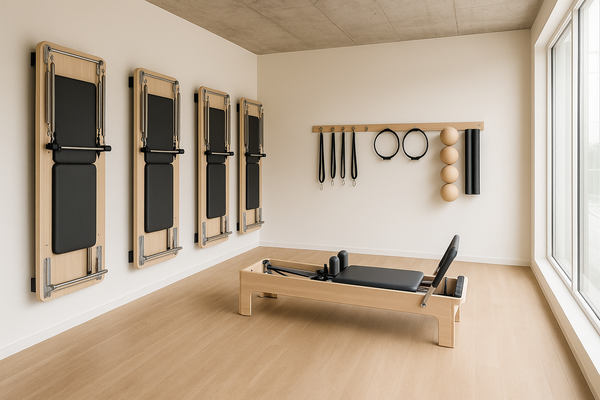
Effective Pilates studio interior design balances flow, layered lighting, quiet aesthetics, sensory comfort, and future-ready features to create spaces where clients' shoulders drop and focus arrives before class begins. The first impression is not reformer brand or paint color, but whether the room invites calm and support.
Emerging design trends for 2026 include hybrid studios with corners optimized for streaming online classes under flattering soft light, touchless check-in systems for modern hygiene and convenience, and sustainability features such as LED lighting, reclaimed wood, and energy-efficient HVAC. These elements combine to create spaces that are functional, memorable, and brand-reinforcing.
Three Revenue Architectures: Private, Group, and Hybrid Models
Studios operate across three primary revenue structures, each with distinct trade-offs. The private-heavy model focuses on one-on-one sessions with lower equipment costs but higher payroll, suited to small footprints in high-income areas. The group reformer model relies on high-volume classes to scale revenue per hour, requiring larger initial equipment investment and a plan to maintain at least 70% occupancy. The hybrid boutique model combines group classes with high-margin private sessions, often proving the most resilient by diversifying income streams.
Franchise disclosure documents show that opening a Club Pilates requires $385,000–$840,000 in startup costs, depending on location and build-out. In return, a mature Club Pilates studio averages approximately $950,000–$1 million in annual revenue per location. Industry estimates for launching an independent Pilates studio in 2026 total approximately $870,000, encompassing capital expenditures and initial operating reserves.
What This Means for Studio Operators
Editorial analysis — not reported fact:
If you are evaluating a franchise system, scrutinize whether the franchisor's expansion pace matches its operational support infrastructure. Brands signing 200 territories in six months face execution risk, territory saturation in premium zip codes, and potential dilution of instructor training quality. Ask specific questions about territory exclusivity radius, build-out timelines, and training academy capacity before committing capital.
If you operate or plan an independent boutique, the Miami design-led studios offer a clear lesson: aesthetics are not superficial when your target client expects spatial cues that signal luxury, intention, and exclusivity. Recovery amenities like infrared saunas and cold plunges create high-margin upsell opportunities and increase session value without additional instructor labor. Consider whether your local market can support $40–$50 single-class pricing and $300+ monthly memberships before investing in high-end finishes.
If you are comparing revenue models, the hybrid approach reduces single-point-of-failure risk. A private-only model struggles if one instructor departs; a group-only model collapses if occupancy falls below 60%. Hybrid studios can weather demand fluctuations by shifting capacity between formats. Build your pro forma with realistic occupancy assumptions (60–70% in year one, climbing to 75–80% by year three) rather than best-case projections, and budget for 12–18 months of operating reserves.
Sources & Further Reading
- ClassPass 2025 booking trends — Data on Pilates as most-booked workout and 66% reservation growth 2024–2025
- Franchise Times coverage of Aligned Fitness and Riser Fitness — Details on Eagle Merchant Partners and Fortress Investment Group capital deployment
- Pilates Addiction franchise information — Territory sales, WundaFormer equipment, and expansion timeline
- JetSet Pilates brand site — Studio openings, Miami headquarters, and Kobi Karp design details
- Studio Pilates International — Global footprint and US expansion plans
- Club Pilates franchise disclosure documents — Startup costs and average unit revenue figures
Editorial coverage of publicly reported industry developments. The Pilates Business has no commercial relationship with any companies named.