Scope of Practice Violations: Liability Risks for Studios
Pilates instructors face hidden liability when client expectations outpace legal scope. How medical referrals, PT collaboration, and documentation protect studios in 2026.

Key Takeaways
- Scope of practice violations void insurance coverage: US Pilates instructors who diagnose, prescribe, or claim to treat injury fall outside their legal scope and lose professional liability protection, leaving personal assets and studio finances exposed.
- Average injury claims cost $25,000: Even when instructors act correctly, misunderstood cues or falls between exercises trigger formal claims, with settlements ranging from $25,000 to $3,000,000 depending on injury severity.
- Waivers do not eliminate gross negligence liability: Signed client waivers reduce litigation risk but do not protect studios from lawsuits alleging unsafe teaching, poor maintenance, or instructor actions outside their scope of practice.
- Medical referral protocols are protective: Instructors who obtain exercise guidelines from a client's physical therapist, physician, or chiropractor before working with injury or pain establish documented collaboration that limits liability exposure.
- Diagnostic language in marketing triggers advertising injury claims: Instructors cannot legally state they "heal," "cure," "treat," or "rehabilitate" conditions; such claims can result in separate advertising injury lawsuits beyond physical accident coverage.
- Manual therapy and self-massage fall in legal gray zones: Pilates classes incorporating hands-on adjustments or client self-massage near endangerment zones (anterior neck, major nerves, blood vessels) require specialized palpation training to avoid scope violations.
Why Scope of Practice Violations Are Rising Liability Concerns in 2026
Pilates instructors and studio operators face a widening gap between client expectations and legal boundaries. Clients increasingly seek medical outcomes from fitness instruction, yet US instructors hold no licensure to diagnose, treat, or rehabilitate injury. This mismatch drives hidden liability risk across the industry in 2026, even as studios require 10 to 20 hours of annual continuing education to maintain credentials and access professional liability insurance.
The core issue is definitional. Scope of practice describes the services a Pilates professional is deemed competent to perform and permitted to undertake. Venturing outside this scope voids insurance coverage, leaving both instructor and studio financially exposed if a client sustains injury. Because Pilates instructors are unlicensed in the United States, they cannot legally claim to offer rehabilitation, diagnosis, or treatment of disease.
What Pilates Instructors Legally Cannot Do
The boundaries are bright-line in regulatory terms but easily blurred in studio practice. Instructors cannot diagnose conditions, prescribe exercises as medical intervention, claim to heal or cure, provide counseling, deliver services requiring licensure, or misrepresent qualifications. For example, an instructor who tells a client "You have scoliosis" has crossed into diagnosis. The legally compliant alternative is observational: "I see that your spine has a lateral curve and your shoulders and hips are uneven. You need a diagnosis from a licensed provider so I know which Pilates protocols to use and whether to refer you to a physical therapist or chiropractor."
Marketing language amplifies risk. Instructors who advertise that they "treat back pain" or "rehabilitate post-surgical clients" make claims that fall outside their scope and trigger advertising injury provisions in liability policies, which typically cover $1,000,000 per occurrence and $3,000,000 annually for claims of privacy violation, reputation harm, or false advertising. Sharing a client success story on social media without written consent or disclosing health information in class can generate separate legal claims beyond physical injury.
How Medical Referral Protocols Protect Studios
Collaboration with licensed healthcare providers is both clinically sound and legally protective. Instructors should receive additional exercise guidelines from a client's physical therapist, chiropractor, osteopath, or physician before designing sessions for clients with injury or chronic pain. This documented communication establishes that the instructor is working within fitness scope rather than attempting rehabilitation.
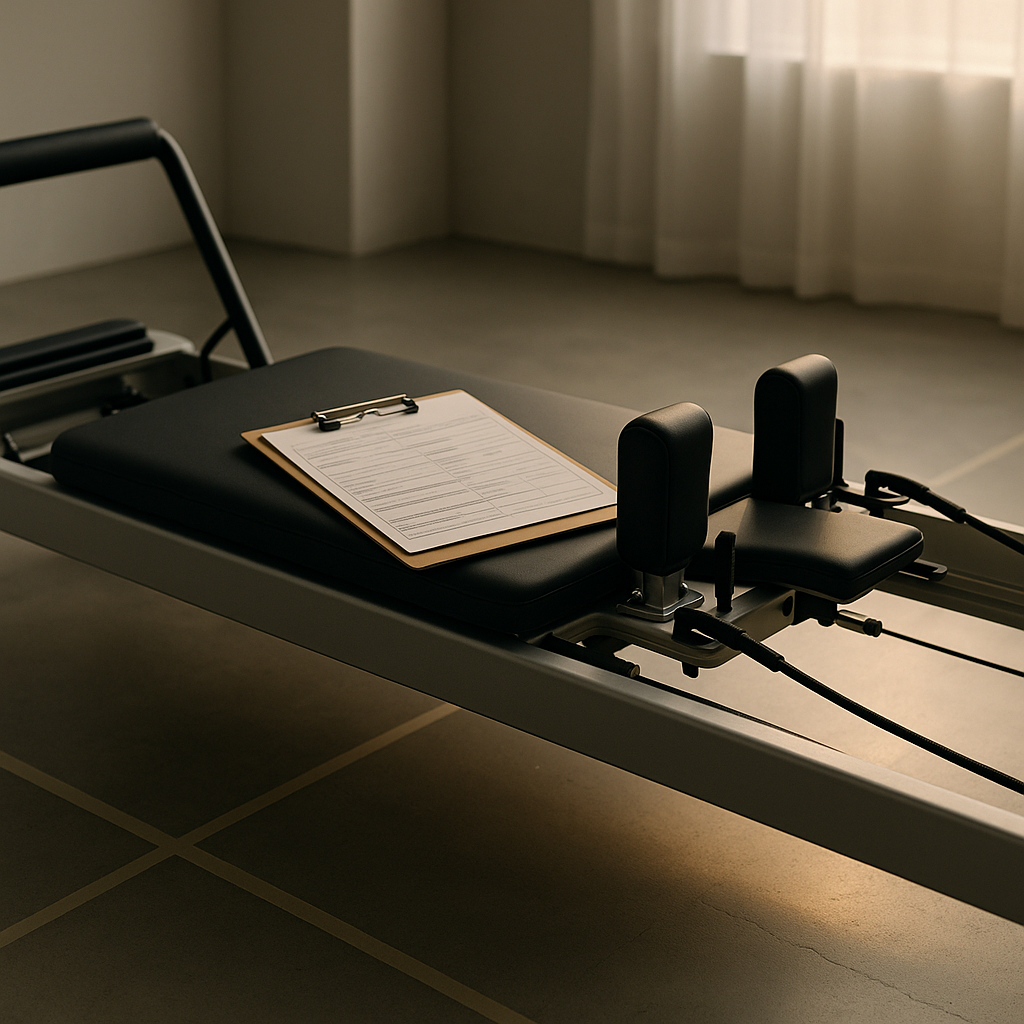
The distinction between Pilates and physical therapy matters to courts. Physical therapy is pathology-focused, centering on a specific injury or area with pain or dysfunction, and builds static stability. Pilates takes a whole-body approach focused on dynamic stability and how all body parts work together in motion. Clients who do not understand this difference may blame instructors when pain increases, even if the instructor stayed within training and scope. Clear intake documentation that records a client's current medical care and any contraindications provides a contemporaneous record in the event of future claims.
Manual Therapy and the Gray Zones of Hands-On Cueing
Pilates instruction does not traditionally contemplate manual therapy, yet classes that include hands-on adjustments or client self-massage enter a regulatory gray area. Licensed massage therapists and manual therapists receive training in endangerment zones, including areas with delicate nerves and blood vessels such as the anterior neck. Instructors without advanced palpation skills who direct clients to self-massage these regions or who perform manual adjustments risk both injury to the client and scope-of-practice violations that void insurance.
Studios should establish written policies on tactile cueing, specifying anatomical regions where contact is permitted and requiring affirmative client consent documented in intake forms. Instructors who hold dual credentials (for example, licensed massage therapist and certified Pilates instructor) must clarify in which capacity they are acting during each session and ensure their insurance covers both roles simultaneously.
Why Waivers Are Necessary but Not Sufficient
Many studio operators believe a signed liability waiver ends their legal exposure. Courts disagree. Waivers mean a client has agreed to assume some risk, but they do not make unsafe teaching, poor maintenance, or instructor actions outside scope permissible. The most significant limitation is gross negligence: a waiver cannot protect a studio from claims that the instructor or facility acted with reckless disregard for client safety.
A Pilates waiver form can reduce potential litigation but does not guarantee complete legal protection. Studios should treat waivers as one component of a broader risk management strategy that includes instructor training on scope boundaries, regular equipment maintenance logs, incident reporting protocols, and client intake procedures that screen for contraindications.
Insurance Costs and Coverage Gaps Instructors Must Know
Professional liability insurance (also called errors and omissions insurance, or E&O) costs instructors an average of $179 to $228 annually, though premiums vary by coverage limits, claim history, and state. Most studios now require independent contractors and employees to carry individual policies rather than relying solely on studio umbrella coverage.
The critical gap: if an instructor ventures outside scope of practice, the insurance policy will not cover resulting claims. A policy that covers "fitness instruction" does not extend to "rehabilitation" or "diagnosis." Instructors should request a specimen policy and review exclusions with their carrier annually, particularly if they add certifications in adjacent modalities such as corrective exercise or functional movement screening.
Financial Exposure from Injury Claims
The financial stakes are substantial. A single incident could lead to unexpected medical bills or formal lawsuits; a misunderstanding during instruction, a fall between exercises, or a cue that wasn't heard correctly has the potential to turn into a formal injury claim averaging $25,000. Settlements in accident cases against gyms and exercise studios typically range from $25,000 to $3,000,000, with fall injury claims involving trips or slips worth $75,000 to $2,500,000 based on injury severity.
These figures reflect both direct medical costs and non-economic damages such as pain, suffering, and lost income. Studios operating without adequate liability coverage or relying on waivers alone may face bankruptcy from a single severe injury claim, particularly if the plaintiff's attorney successfully argues gross negligence or scope-of-practice violation that voids insurance.
What This Means for Studio Operators
Editorial analysis — not reported fact:
Studio operators should treat scope-of-practice compliance as a non-negotiable operational priority in 2026, not a discretionary best practice. The simplest protective measures are documentation-driven: require all instructors to use intake forms that capture current medical care, signed releases for communication with treating providers, and annual attestations that the instructor has reviewed scope boundaries and will not diagnose, prescribe, or claim to treat injury.
Invest in quarterly staff training on language that crosses legal lines. Role-play client scenarios where someone asks "Can you fix my herniated disc?" or "Should I stop physical therapy now that I'm doing Pilates?" Equip instructors with scripted responses that affirm the value of their work while clearly delineating it from medical care. For example: "I can design a session that supports your overall movement health, but I need guidance from your physical therapist on any modifications specific to your disc injury."
For studios working with post-rehab or medical populations, formalize referral partnerships with local physical therapists, chiropractors, and orthopedic physicians. Document these relationships and request written exercise protocols for shared clients. This creates a paper trail showing the studio operated within fitness scope and deferred to licensed providers on medical questions. It also builds a referral network that enhances revenue while reducing liability.
Finally, audit marketing materials and social media quarterly. Remove any language that promises to "heal," "treat," "cure," or "rehabilitate." Replace outcome claims ("eliminate back pain") with process descriptions ("improve core stability and movement patterns"). This shift protects against both scope violations and advertising injury claims, which are separately actionable even when no physical injury occurs.
Sources & Further Reading
- Scope of practice definition for Pilates professionals — overview of permitted and prohibited services for unlicensed movement instructors in the US
- Legal boundaries: what Pilates instructors cannot do — specific prohibitions on diagnosis, prescription, treatment claims, and misrepresentation of credentials
- Advertising injury coverage in professional liability policies — protection limits and common claim scenarios involving privacy, reputation, and false advertising
- Medical referral protocols for fitness instructors — best practices for obtaining exercise guidelines from licensed healthcare providers
- Differences between Pilates and physical therapy — pathology-focused vs. whole-body approaches and static vs. dynamic stability
- Manual therapy and endangerment zones in Pilates — risks of hands-on adjustments and self-massage cueing without specialized training
- Limitations of liability waivers in fitness settings — why waivers do not protect against gross negligence or actions outside instructor scope
- Pilates waiver forms: legal protections and gaps — how waivers reduce but do not eliminate litigation risk
- Professional liability insurance costs for Pilates instructors — average annual premiums and coverage limits for errors and omissions policies
- Insurance policy exclusions for scope-of-practice violations — how acting outside legal boundaries voids coverage
- Average cost of injury claims in fitness studios — financial exposure from misunderstood cues, falls, and instruction errors
- Settlement ranges for gym and studio accident cases — typical compensation for fall injuries and severity-based valuation
Editorial coverage of publicly reported industry developments and legal standards. The Pilates Business has no commercial relationship with any companies, insurers, or legal service providers named.