Power Pilates Certification: Cost, Curriculum & ROI Analysis
Power Pilates' $5,495 classical certification costs 3-7x online alternatives. We analyze the 600-hour program's employment value, lineage premium, and ROI.

Key Takeaways
- Program cost: Power Pilates Comprehensive certification costs $5,495 for most US programs ($6,495 for certain intensive formats), with a 600-hour training requirement spanning 6-12 months—substantially higher than $799-$3,000 online alternatives.
- Classical lineage advantage: Power Pilates maintains direct teaching lineage to Romana Kryzanowska and follows Joseph Pilates' original exercise order and vocabulary, positioning graduates for roles in studios that prioritize classical methodology over contemporary adaptations.
- Employment recognition: Graduates report immediate eligibility to work at major chains like Club Pilates and Equinox, with NPCP, ACE, NCBTMB, and CanFitPro recognition broadening job market access.
- ROI timeline considerations: With average annual instructor pay at $70,426 but entry-level earnings starting in the $20,000-$35,000 range, the $5,500+ upfront investment represents 16-27% of first-year part-time income.
- Renewal requirements: The Assessment-Based Certificate (ABC) expires every two years and requires completion of Power Pilates continuing education courses, adding ongoing cost and time commitments throughout a career.
- Bridge pathways: Existing certified instructors can access a 45% discount on Comprehensive training, reducing the barrier for instructors seeking to add classical credentials or apparatus skills.
Program Structure and Investment Required
Power Pilates offers a 600-hour Comprehensive certification spanning 6-12 months, with pricing set at $5,495 for most US training centers. The NYC location charges $700 for the foundational Mat I course compared to $650 elsewhere, and certain intensive formats reach $6,495 total. The program includes weekend intensives, apprenticeship requirements, and exams conducted at 100, 300, 400, and 600-hour benchmarks.
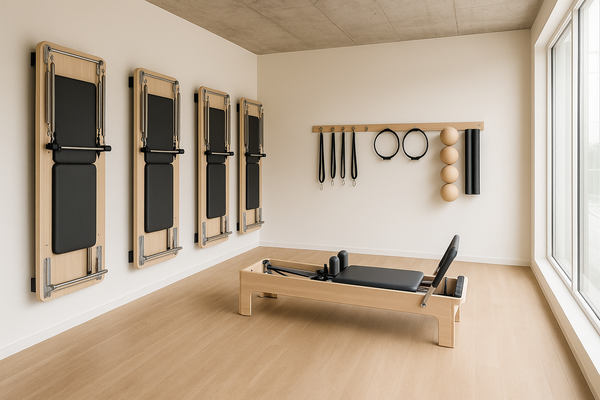
The curriculum covers all classical apparatus—Mat, Reformer, Cadillac, Chair, Barrels, Ped-o-Pull, and Magic Circle—plus special populations including pregnancy, obesity, and orthopedic conditions. Power Pilates describes the training as covering beginner through advanced exercises with integrated theory and practical application. A Comprehensive Intensive option condenses the same 600-hour requirement into 450 hours of intensive instruction plus self-study periods between sessions.
For instructors already holding certifications from other programs, the Bridge pathway offers a 45% discount on Comprehensive training. Full scholarships are available to exceptional candidates at the NYC flagship location, though eligibility criteria and award frequency are not publicly detailed.
Classical Lineage and Curriculum Philosophy
Founded in 1997, Power Pilates was developed by a chiropractor and three master teachers all trained by Romana Kryzanowska in the early 1980s. By 2000, the organization positioned itself as the dominant force in classical Pilates education, having since certified over 7,000 instructors worldwide.
The program's classical philosophy preserves Joseph Pilates' original teachings, exercise vocabulary, and sequencing. Power Pilates distinguishes its classical approach from contemporary programs that adapt or reinterpret exercises, emphasizing systematic progression and integrative methodology. This adherence to historical lineage creates both a credential advantage in studios seeking classical purity and a potential constraint in environments favoring functional or rehabilitative modifications.
The 600-hour duration exceeds the 450-hour threshold widely cited as comprehensive across the industry. Programs under 400 hours typically represent abbreviated foundation training, while 400-hour certifications cover minimum apparatus range.
Industry Recognition and Hiring Market Position
Power Pilates holds recognition from the National Pilates Certification Program (formerly PMA), American Council on Exercise (ACE), National Certification Board for Therapeutic Massage & Bodywork (NCBTMB), and CanFitPro. This multi-organization recognition translates to continuing education credits and baseline credibility across diverse employment settings.
Student reviews on Indeed highlight immediate employability at Club Pilates and Equinox as a key program benefit, alongside access to discounted liability insurance accepted across studios. The apprentice program provides a 50% discount on semi-private sessions during training, reducing out-of-pocket practice costs.
Third-party certification guides position Power Pilates alongside Core Pilates NYC as the top recommendation for maximum job opportunities when seeking comprehensive classical training. However, the same sources note that Club Pilates' own 450-hour program and lower-cost alternatives like ISSA's $799 online certification also meet hiring criteria at many franchise and boutique locations.
Cost Comparison and Return on Investment
At $5,495 to $6,495, Power Pilates sits at the upper end of comprehensive certification pricing. Industry surveys show comprehensive programs ranging $2,199 to $7,600 depending on provider and location. Online-only options like ISSA's $799 certification require no prerequisites and offer faster completion timelines, though without hands-on apparatus training or classical lineage credentials.
ZipRecruiter reports the average annual Pilates instructor salary at $70,426 as of August 2026, translating to approximately $33.86 per hour. However, entry-level instructors working part-time or in smaller studios typically earn $20,000 to $35,000 in their first year. Most instructors fall within a $48,000 to $86,000 annual range, with variation driven by geographic market, apparatus certification breadth, and compensation structure (per-class vs. per-hour vs. per-private-session).
For a newly certified instructor earning $25,000 in year one, the $5,500 investment represents 22% of gross income before accounting for ongoing costs. One instructor cited in industry forums reported spending nearly $6,000 on initial Power Pilates certification, raising questions about payback period when compared to $800-$2,500 alternatives that meet baseline hiring requirements at many studios.
Ongoing Certification Requirements and Career Costs
The Power Pilates Assessment-Based Certificate (ABC) expires every two years. Renewal requires completion of multiple Power Pilates continuing education courses before the expiration date, adding recurring costs and time commitments throughout an instructor's career. While specific CE course pricing is not publicly listed, the proprietary requirement limits instructors' ability to fulfill renewal through lower-cost or more geographically accessible third-party workshops.
Over a 10-year teaching career, this biennial renewal cycle represents five separate CE obligations. Instructors must budget not only for course fees but also for travel to Power Pilates training centers if local CE options are unavailable, particularly outside major metropolitan areas where the organization maintains physical locations.
What This Means for Studio Operators
Editorial analysis, not reported fact:
Studio operators hiring Power Pilates graduates are acquiring instructors trained in a specific pedagogical lineage that carries market cachet in classical-focused environments. If your studio brand emphasizes authentic, unmodified Pilates methodology or caters to clients seeking traditional exercise sequencing, Power Pilates certification serves as a reliable credential filter. The 600-hour requirement and apparatus breadth suggest these instructors arrive with more hands-on practice time than peers from shorter programs.
However, the certification's cost and renewal structure create workforce planning considerations. Instructors carrying $5,500+ in training debt may negotiate harder on hourly rates or require faster pathways to private-client work to justify their investment. The biennial proprietary CE requirement also means these instructors face ongoing credentialing costs that may influence their long-term retention in lower-paying markets or part-time roles.
For operators building teams across multiple locations or recruiting in competitive metro markets, the employment flexibility Power Pilates graduates report—immediate eligibility at Club Pilates, Equinox, and other chains—also means these instructors have more exit options. Retention strategies should account for the fact that their certification opens doors beyond your studio. Conversely, if you operate in a market where classical lineage commands premium pricing, hiring Power Pilates graduates allows you to substantiate higher class fees and private session rates with documented instructor pedigree.
The 45% Bridge discount for existing instructors presents an interesting recruitment tool. If you employ competent teachers certified through shorter or contemporary programs, sponsoring their Power Pilates Bridge training—or offering partial reimbursement contingent on continued employment—can deepen your bench strength while fostering loyalty. The $3,022 Bridge cost (45% off $5,495) may deliver better ROI than recruiting pre-certified candidates in tight labor markets.
Sources & Further Reading
- Power Pilates Certification Overview, program structure and industry recognition details
- Power Pilates Comprehensive Training, curriculum scope and pricing
- Power Pilates History, organizational lineage and founding details
- Classical vs. Contemporary Pilates, pedagogical philosophy distinctions
- ZipRecruiter Pilates Instructor Salary Data, August 2026 national averages
- Breathe Education Pilates Earnings Analysis, entry-level and experienced instructor income ranges
- Indeed Power Pilates Reviews, student experience and employment outcomes
- FitnessTrainer.com Best Pilates Certifications Guide, comparative program recommendations
- Trainer Academy Pilates Certification Rankings, cost and curriculum comparisons
Editorial coverage of publicly reported industry developments. The Pilates Business has no commercial relationship with any companies named.