Premium Franchises & Design-Driven Growth in 2026 Pilates
JETSET hit $1.13M AUV while Pilates reservations surged 66% year-over-year. How leading franchises and independents are competing through design, programming, and hybrid models.

Key Takeaways
- Premium franchise growth accelerated: JETSET Pilates reached 270+ studios with a $1.13 million systemwide AUV in 2025, while Studio Pilates International reported a record $888,774 AUV and Bodybar Pilates is targeting 70+ openings in 2026.
- Strength-forward programming dominates expansion: The fastest-growing franchises emphasize muscular endurance, continuous load, and athletic results over classical formats, with Bodybar Pilates offering nearly 10 class types to serve middle-ground clients.
- Design has become a competitive asset: Leading studios are investing in warm minimalism, quiet luxury aesthetics, custom millwork, acoustic treatments, and integrated AV technology, with reception areas positioned as critical transition zones for client experience.
- Pilates reservations surged 66% year-over-year: ClassPass reported Pilates as the most-booked workout for the third consecutive year, while the percentage of studios offering Pilates jumped from 17% in 2021 to 45% in 2025.
- Hybrid business models prove most resilient: Studios blending group classes with high-margin privates maintain profitability by keeping payroll between 30–40% of revenue while rising rents and franchise competition pressure margins.
- Market valuation projects explosive growth: The Pilates & Yoga Studios market reached $142.30 billion in 2025 and is projected to grow at 14.5% CAGR through 2034, reaching $479.52 billion.
Premium Franchises Scale Through Luxury Positioning and Athletic Programming
The franchise landscape shifted decisively in 2025 toward premium positioning and strength-based programming. JETSET Pilates closed 2025 with 24 new studio openings, bringing its total to more than 270 locations and achieving a systemwide AUV of approximately $1.13 million. The brand opened a new Miami headquarters in the Wynwood district designed by architect Kobi Karp and announced UK expansion plans.
JETSET differentiates through what it calls "luxury-driven" experiences centered on high-tension, low-impact training with continuous load and athletic outcomes, departing from traditional classical and contemporary Pilates formats. This strength-forward approach mirrors broader market trends, with the strongest studio growth coming from classes emphasizing muscular endurance, control, and full-body efficiency.
Studio Pilates International reported a record $888,774 AUV with 125+ studios globally and more than 70 in development. The brand opened Q1 2026 locations in Spears Creek, South Carolina, and Hudson Square, New York, while expanding internationally into Germany and Portugal. Studio Pilates positions itself with luxurious custom reformers, polished hardwood floors, signature chandeliers, and real-time AV guidance technology.
Mid-Market Franchises Target Position Between Classical and Athletic Extremes
Bodybar Pilates signed its 150th franchise agreement in 2025 with 60% footprint growth, adding 27 new studios to reach 73 open locations across 21 states. The brand is targeting more than 70 openings in 2026 with an additional 130 to 200 units in development.
Bodybar explicitly positions itself as middle ground between classical formats like Club Pilates and aggressive athletic brands such as Solidcore, offering nearly 10 different class types including both "balanced" and "athletic" options. This diversification strategy addresses a market segment seeking more intensity than traditional Pilates but less extreme programming than pure strength training.
Pilates Addiction, operating under Sequel Brands founded by former Xponential Fitness founder Anthony Geisler, surpassed 200 territories sold after opening its first studio in May 2025. The brand is led by Sarah Luna, former executive for Club Pilates and Pure Barre, and plans to have more than 100 studios open by the end of 2026. Pilates Addiction debuted the Aurum, a gold patented WundaFormer machine combining reformer, jump board, ballet barre, and Wunda Chair into a single system.
Studio Design Evolves From Afterthought to Brand Differentiator
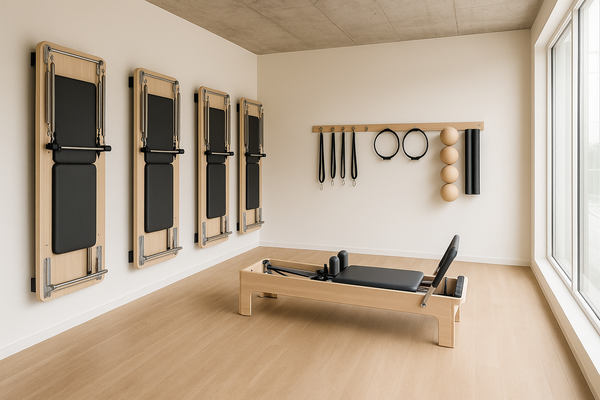
As competition intensifies, leading studios are investing significantly in design as a competitive moat rather than treating aesthetics as secondary. Hot Pilates hired HUXHUX Design to create their first Reformer studio in West Hollywood with clean lines, natural light, soft neutrals and warm woods, custom millwork, acoustic treatments, integrated lighting, and curated graphic moments.
The Pilates Class in West Hollywood, co-founded by Natasha Oakley and Jacqui Kingswell, was designed by Dave Corbin of Studio Corbeau with an explicit brief for minimal, neutral "quiet luxury" that feels warm, simple, and peaceful. The final aesthetic is warm, minimal, natural, and texturally rich with a restrained color palette, creating an environment where clients feel relaxed and pampered.
Modern design guidance emphasizes reception areas as critical entry points where clients transition from busy schedules into practice mode. Lighting has emerged as particularly important, with natural light as the ideal, soft ambient lighting around 300 to 500 lux, warm LED accents at 2700 to 3000K color temperature, and dimmable fixtures for adjustable ambiance.
Emerging trends include hybrid studios with dedicated streaming corners using soft lighting, touchless check-in systems, and sustainability features such as LED lighting, reclaimed wood, and energy-efficient HVAC. Leveaux Pilates in the Ardmore area is expanding with a heated mat sister studio designed by Studio Whitford, with owner Alexa Goldman positioning the beautiful space as integral to her value proposition for community building.
Market Growth Outpaces Most Fitness Segments as Demand Surges
The percentage of studios offering Pilates grew from 17% in 2021 to 45% in 2025, reflecting explosive demand across the fitness industry. Pilates was the most-booked workout on ClassPass for the third consecutive year, with reservations increasing 66% between 2024 and 2025.
The Pilates & Yoga Studios market was valued at $142.30 billion in 2025 and is projected to grow at 14.5% compound annual growth rate from 2026 to 2034, reaching $479.52 billion by 2034. This growth trajectory significantly outpaces the broader fitness industry and reflects both increased consumer awareness and expanded access through franchise proliferation.
However, this rapid expansion brings challenges. Rising rents, increased competition from franchises like Club Pilates, and tighter labor markets are challenging profitability for both independent and franchise operators. Key drivers of profitability include recurring revenue through memberships, manageable rent ratios, efficient staffing models, and sustainable owner roles that don't require constant on-floor instruction.
Hybrid Business Models Prove Most Resilient as Competition Intensifies
Pilates studios typically operate three distinct models: private-heavy studios focusing on one-on-one sessions with lower equipment costs but higher payroll, hybrid boutique studios blending group classes with high-margin privates, or group-focused studios maximizing class capacity. The hybrid model has proven most resilient during the current competitive environment.
Financial discipline around labor costs remains critical, with successful studios keeping payroll between 30 to 40% of total revenue to ensure profitability after covering overhead including rent, equipment maintenance, and marketing. Studios exceeding this threshold often struggle with cash flow despite high class attendance.
Studios are maximizing profitability through loyalty programs, membership packages including both in-studio and online classes, corporate wellness partnerships, and targeted programs for seniors, rehabilitation, prenatal, and postnatal clients. In 2026, more studios are offering a "smart mix" of online and offline rather than forcing clients to choose exclusively between formats.
Community building has emerged as a retention strategy distinct from programming, with studios organizing workshops, challenges, and social gatherings. Studios are positioning themselves as communities where people connect with like-minded members, creating switching costs that transcend class quality or pricing.
What This Means for Studio Operators
Editorial analysis — not reported fact:
The 2025–2026 data reveals a maturing market where differentiation matters more than proximity. If you operate in a market where a premium franchise has opened or is planned, competing on programming alone will be difficult. The franchises growing fastest have invested heavily in brand systems, including design standards, equipment innovation, and instructor training protocols that independents struggle to match without significant capital.
The hybrid business model's resilience suggests that studios relying exclusively on group classes face the highest risk as competition increases. Adding private or semi-private sessions creates margin cushion and builds deeper client relationships that reduce churn. For operators currently at 100% group capacity, the 30–40% payroll benchmark means you likely need to raise prices, add privates, or reduce instructor compensation per class, none of which are easy conversations.
Design investment is no longer optional for new builds or major renovations. The studios profiled here are treating reception areas, lighting systems, acoustic treatments, and finish materials as marketing expenses, not just construction costs. If your studio feels dated compared to a new franchise location three blocks away, clients will notice before you lose them. Budget 15–20% more than your initial design estimate and prioritize lighting and acoustics over decorative elements.
The 66% year-over-year increase in ClassPass Pilates bookings signals that discovery platforms now drive meaningful volume, particularly for new studios without established communities. However, ClassPass's discounted rates compress margins, so treat platform traffic as a client acquisition cost with a clear plan to convert visitors to direct members within three to five visits. Studios without this conversion funnel are essentially subsidizing ClassPass's business model.
Sources & Further Reading
- JETSET Pilates soars to new heights with 24 new locations (Franchising.com) — franchise growth, AUV data, and UK expansion plans
- Studio Pilates International surpasses 125 studios globally (Franchising.com) — AUV performance and Q1 2026 openings
- Bodybar Pilates experiences 60% footprint growth in 2025 (Franchising.com) — franchise agreements and positioning strategy
- Pilates Addiction surpasses 200 territories sold (Franchising.com) — Sequel Brands expansion and Aurum equipment launch
- The future of Pilates franchises in 2025 and beyond (Franchising.com) — programming trends and ClassPass booking data
- Hot Pilates Reformer studio design (HUXHUX Design) — West Hollywood studio design case study
- The Pilates Class design project (Studio Corbeau) — quiet luxury aesthetic approach
- Pilates studio design guide (Pilates Encyclopedia) — lighting, reception areas, and emerging trends
- Pilates studios in Main Line (Main Line Today) — Leveaux Pilates expansion
- Why do Pilates studios fail? (Pilates Encyclopedia) — business model analysis and profitability drivers
- Pilates and Yoga Studios market report (Business Research Insights) — market valuation and growth projections
Editorial coverage of publicly reported industry developments. The Pilates Business has no commercial relationship with any companies named.