Small-Space Storage Solutions for Boutique Pilates Studios
Vertical storage reformers, wall-mounted systems, and circuit class models help operators maximize limited square footage and reduce real estate costs in 2026.

Key Takeaways
- Space planning benchmarks: A standard eight-reformer boutique studio requires 900–1,100 sq ft total, but operators are successfully opening smaller footprints down to 500 sq ft using vertical storage and circuit class models.
- Vertical storage reformers are the highest-impact equipment investment for small studios in 2026, with models like the Allegro Nextgen Reformer featuring upright storage and streamlined designs that preserve floor space between classes.
- Budget 40–60 sq ft minimum for dedicated storage zones or risk safety hazards, visual clutter, and instructor retention problems; wall-mounted racks, hooks, and vertical towers are the most efficient solutions.
- Real estate remains the second-largest expense after equipment, and Sun Belt secondary markets continue to see strong landlord pricing power on smaller storefront suites in 2026, making smart space utilization a competitive necessity.
- Circuit class programming lets studios maximize reformer capacity by splitting students between reformer-based and mat-based exercises, reducing the number of machines needed in limited square footage.
The Space Math Every Operator Needs to Know
Getting your studio footprint calculation wrong is one of the most expensive mistakes a Pilates operator can make. A standard eight-reformer boutique studio needs approximately 900–1,100 sq ft total, allowing 40–50 sq ft per reformer on the workout floor, plus 300–500 sq ft for reception, storage, changing, and circulation.
But smaller studios are now commonplace. A 500 sq ft studio can fit approximately 8–10 reformers if the layout is maximized, while an 800–1,000 sq ft studio can comfortably accommodate 4–6 reformers plus a small mat or stretch area and reception space. The key constraint is per-station clearance: a minimum of 8 x 6 ft (48 sq ft) is needed per reformer, with 8.5 x 7.5 ft (about 64 sq ft) recommended for comfortable group teaching. That extra space covers instructor circulation, client entry and exit, and safety margins.
The most common mistake is not reserving enough storage. Budget at least 40–60 sq ft for equipment storage or you will end up stacking things in the corners of the studio floor, which is both a safety hazard and a visual one. A studio that fits six reformers on paper but has no room for reception, storage, or a waiting area becomes a difficult working environment that costs operators in client experience and instructor retention before year two.
Vertical Storage Reformers and Multi-Functional Equipment
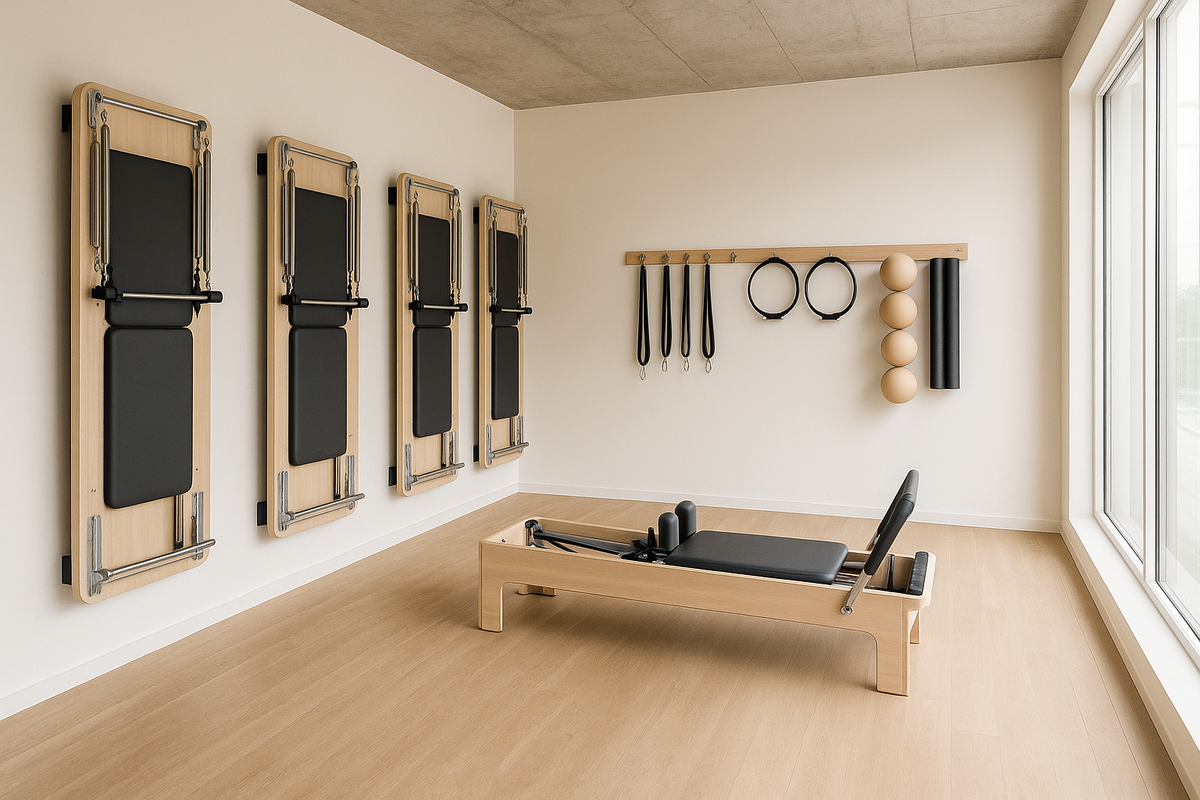
The most impactful equipment trend in 2026 is the rise of vertically-storable reformers and wall-integrated systems. Foldable reformers and vertical storage can help maximize available space in smaller footprints, and manufacturers are delivering on this demand with production-grade solutions.
The Allegro Nextgen Reformer features easy portability and storage standing up, plus a streamlined design and updated color palette that elevates studio aesthetics. Vertical-storage reformers offer a full-length, non-folding frame that simply stands upright when not in use, providing the highest level of stability without requiring a permanent floor commitment. No hinges or locking points mean the rails remain in 100 percent permanent alignment, addressing durability concerns that plagued earlier folding models.
Choosing multi-functional equipment like combo reformer/Cadillac units can give you more programming flexibility without requiring more floor space. The Chair and Ladder, for instance, combines stretching and core work in one footprint, making it a high-value addition to compact studios.
Wall-Mounted Storage and Designated Accessory Zones
Wall mounts and hooks are great for Pilates equipment storage; hang spine correctors, spacer boxes, or small barrels with weight-rated hooks. Walls are an underutilized asset in small studios. You can install wall units in this vertical space to store accessories like mats, resistance bands, hand weights, and yoga blocks.
For studios with limited square footage, vertical storage towers that combine mat storage with shelves for smaller accessories consolidate all storage into one area and maximize vertical space. Wall-mounted mat racks are the most space-efficient solution; they keep mats rolled and off the floor while allowing them to air dry between uses. Install mat racks at least 30 cm from the wall to allow air circulation and prevent mold growth.
The most effective approach treats storage as an integrated part of studio layout, not an afterthought. Designate specific zones for spring storage, strap storage, and mat storage, keeping frequently used items at arm's reach from reformer stations and storing seasonal or specialty accessories in labeled bins on higher shelves. Use benches or cabinets with hidden compartments to store towels, mats, and smaller equipment when not in use, which helps declutter the studio and makes it more visually appealing.
Why Storage Affects Client Perception
A disorganized studio sends a clear message to clients: we do not care about details. Tangled straps, mixed springs, and scattered accessories create a cluttered environment, slow down class transitions, and increase equipment damage. Effective storage solutions keep the studio looking professional, protect equipment from premature wear, and reduce the time staff spend on organization tasks.
Layout Strategies and Circuit Class Models
Place large equipment such as Reformers along the walls, leaving the center of the studio for mat work; this layout allows for flexibility in class types and encourages flow in movement. Consider using modular furniture that can be easily rearranged to accommodate different class setups. Mirrors create the illusion of a larger space while helping clients maintain proper form.
Focusing on circuit classes is a great way to get the most out of a limited space. In circuit classes, split students between reformer-based and mat-based exercises, so you will not need to set up multiple reformers in limited spaces. This programming model is particularly effective for studios in the 500–800 sq ft range, where reformer count is the binding constraint.
Consider offering multi-functional spaces where classes can be held in the morning and transformed into a wellness area in the afternoon, all while utilizing the same footprint. This flexibility can maximize your investment and attract more clients. Pilates needs less footprint per active member than CrossFit or HYROX; a single Reformer supports 35–50 paid bookings per week versus an open-floor square footage requirement for functional fitness.
Real Estate Cost Realities in 2026
Commercial real estate is the second-largest line item after equipment for most Pilates operators, and it has moved meaningfully in 2025 and 2026. According to industry real estate analysis, primary-market street retail rents in cities like New York and San Francisco remained at historic highs, while Sun Belt secondary markets continued to see strong landlord pricing power on smaller storefront suites favored by boutique fitness.
Most boutique Pilates studios fall between 1,200 and 2,000 square feet, and buyers are very familiar with this range. Eight to ten Reformers is the most common starter configuration for a contemporary US studio; fewer than eight makes it hard to amortize the rent and staffing line, while more than twelve quickly outgrows a typical 2,000 sq ft suite and forces a larger lease commitment in year 1.
This math makes space efficiency a direct profit driver. A studio that can deliver ten reformer stations in 1,000 sq ft instead of 1,400 sq ft saves several thousand dollars per month in rent in high-cost markets, while still supporting the same class capacity and revenue potential.
What This Means for Studio Operators
Editorial analysis, not reported fact:
The convergence of high real estate costs and better vertical storage technology creates a window for operators to rethink their lease strategy in 2026. Instead of automatically targeting 1,500–2,000 sq ft spaces, consider whether a well-planned 900–1,100 sq ft suite with vertical-storage reformers and wall-mounted accessory systems can deliver the same class capacity at a meaningfully lower rent line. The savings compound quickly when you factor in lower HVAC costs, faster build-out timelines, and reduced cleaning and maintenance labor.
For operators already locked into leases, the investment in vertical storage reformers and wall-mounted systems can pay back within 12–18 months if it allows you to add even one or two more reformer stations to your floor. That translates to 70–100 additional weekly class slots over the life of a five-year lease, which can mean $50,000–$100,000 in incremental revenue depending on your pricing model.
The storage zone budget of 40–60 sq ft is non-negotiable. Treat it as a fixed cost in your planning, just like ADA-compliant restrooms or fire exits. Skipping it to squeeze in one more reformer creates downstream problems that are expensive to fix and hurt instructor morale. A clean, organized studio also supports premium pricing, which matters more than an extra reformer in most markets.
Sources & Further Reading
- Studio Growth space planning guide, detailed benchmarks for reformer studio footprints
- Megacore Pilates reformer storage solutions guide, comprehensive equipment storage best practices
- Balanced Body Allegro Nextgen Reformer, vertical storage reformer product specifications
- The Kind Motion vertical storage comparison, folding versus non-folding reformer analysis
- Mariana Tek modern Pilates studio design guide, layout and flow strategies
- Boutique Fitness Broker cost analysis, real estate and equipment cost benchmarks
Editorial coverage of publicly reported industry developments. The Pilates Business has no commercial relationship with any companies named.