Smart Equipment & Design Drive 2026 Pilates Buying Decisions
Connected reformers, sustainability features, and franchise expansion reshape commercial equipment purchases as the $5.4B market heads toward $11B by 2035.

Key Takeaways
- Market growth accelerates: The Pilates equipment market reached $5.353 billion in 2024 and is projected to hit $11.07 billion by 2035, with North America posting the highest regional growth rate at 37.7% and the sector valued at approximately $210 million in 2026.
- Smart equipment drives retention: Studio owners report a 25% increase in client retention when using high-quality equipment, while technological integration with app connectivity and guided workouts improves user engagement by over 20%.
- Equipment investment scales with volume: Commercial reformers range from $3,500 to over $8,000 per unit, with bulk discounts reaching 18-25% for orders of 16+ reformers; fully equipping a studio costs $35,000 to $65,000 excluding shipping and installation.
- Consolidation reshapes supplier landscape: Merrithew acquired UK-based Align-Pilates in November 2024, while iFIT's acquisition of Reform RX signals major investment in connected reformer technology that bridges traditional Pilates with smart resistance and adaptive feedback.
- Franchise expansion creates equipment demand: Pilates Addiction sold over 200 territories since launching in June 2025 and plans to open over 100 studios by end of 2026, while Riser Fitness secured $72 million from Fortress Investment Group to accelerate growth.
Connected Technology Transforms Commercial Equipment Standards
The commercial Pilates equipment market is undergoing its most significant transformation since Joseph Pilates first designed the reformer. In 2026, smart reformers now share the same DNA as connected treadmills and bikes, featuring smart resistance, adaptive feedback, and personalized programming. This shift represents what industry observers are calling Pilates' "intelligent era."
According to Athletech News reporting on 2026 equipment trends, reformers and platforms now quietly adapt to individual users, measuring effort, guiding alignment, and elevating technique without interrupting flow. The data validates this approach: technological integration with app connectivity and guided workouts improves user engagement by over 20%, per Technavio's market analysis.
iFIT's acquisition of Reform RX, a connected reformer company, signals that major fitness technology players view Pilates equipment as the next frontier for smart integration. This move positions connected reformers alongside Peloton bikes and Tonal strength systems as premium at-home and studio equipment categories.
Market Growth Creates Urgency Around Equipment Investment Decisions
The Pilates equipment market reached $5.353 billion in 2024 and is projected to hit $11.07 billion by 2035, according to Verified Market Reports. Near-term momentum is even stronger: Technavio forecasts the market will grow at a CAGR of 14.2% during 2026-2030.
North America leads this expansion. The region's Pilates equipment segment was valued at approximately $210 million in 2026, per Accio Business analysis, and North America will register the highest growth rate of 37.7% among all regions, creating significant opportunities for equipment vendors during the forecast period.
Studio operators report direct financial benefits from quality equipment investment. Studios experience a 25% increase in client retention when using high-quality equipment, making apparatus selection a direct profitability lever rather than a one-time capital expense.
Pricing Structure and Bulk Purchase Economics for Studio Operators
Commercial equipment pricing reflects brand positioning and feature sets. Gratz reformers, as the original manufacturer licensed by Joseph Pilates, typically cost $4,500 to $7,000, according to industry supplier analysis, while Balanced Body's flagship Allegro and Rialto lines run $3,000 to $5,500. Across brands, a fully outfitted commercial reformer from a reputable brand typically ranges from $3,500 to over $8,000 per unit.
Total studio buildout costs scale accordingly. The estimated cost to fully equip a Pilates studio ranges from $35,000 to $65,000 for new equipment, excluding shipping and installation, per Peak Primal Wellness analysis of commercial buying patterns.
Volume purchases unlock significant savings. Bulk discount tiers include 5-10% off for 5-8 reformers, 12-18% off for 10-15 reformers, and 18-25% off for orders of 16 or more reformers. For franchise operators opening multiple locations, these discounts represent tens of thousands in savings per studio.
Brand Consolidation and Strategic Acquisitions Reshape Vendor Landscape
Three heritage brands continue to dominate commercial sales, each with distinct positioning. Balanced Body pioneered the modernization of Pilates equipment and remains a global leader with comprehensive product offerings spanning studios, rehabilitation, and teacher training. Merrithew redefined Pilates with a contemporary, science-based approach, and its STOTT Pilates education system holds premium positioning in professional and rehabilitation markets. Gratz serves as the original manufacturer directly licensed by Joseph Pilates and anchors the classical Pilates segment with niche premium positioning.
Recent M&A activity signals market maturation. In November 2024, Merrithew acquired UK-based Align-Pilates and its parent company T.L. Elliott & Co Ltd., expanding its global manufacturing and distribution footprint. This cross-border consolidation follows the broader pattern of established brands acquiring regional players to capture franchise and boutique studio growth.
The home fitness segment creates a parallel growth channel. The Home Users segment is projected to expand from $2.653 billion in 2024 to $6.07 billion by 2035, according to Verified Market Reports, driven by a 40% rise in online sales for direct-to-consumer brands.
Design Innovation: Sustainability and Space Efficiency Meet Studio Economics
2026 features a rise of modular, space-efficient, and sustainable systems, per Athletech News reporting on design trends. Manufacturers are investing in recyclable materials, quieter mechanical systems, and sleeker footprints that allow operators to deliver more value per square meter.
Material innovation shows concrete results. The new Bravo Reformer features an eco-friendly recycled polywood frame with over 256 plastic bottles used in every reformer, demonstrating that sustainability features are moving from marketing differentiators to standard specifications.
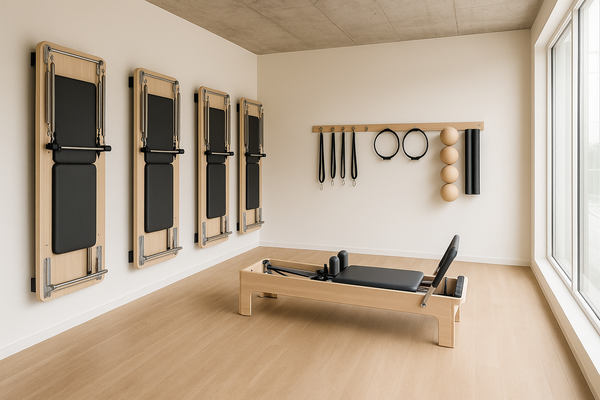
Smaller or boutique studios may benefit from foldable reformers like Peak Fit or Align F3, or modular setups that can be rearranged easily, according to commercial equipment buying guides. This flexibility matters as studios adapt class formats and test hybrid programming models.
Franchise Expansion Drives Equipment Volume Demand Through 2026
Franchise growth creates immediate equipment procurement cycles. Pilates Addiction, part of Anthony Geisler's Sequel Brands, has already sold over 200 territories across U.S. states despite only launching its franchise program in June 2025, with plans to have over 100 studios open by the end of 2026, per Pilates Journal's industry leader predictions.
Established franchises continue geographic expansion. Club Pilates remains the largest brand by studio count with over 1,300 locations globally. Riser Fitness, a franchisee group led by former Club Pilates president Mike Gray, received $72 million from Fortress Investment Group to accelerate multi-unit development.
This franchise velocity creates equipment standardization pressures. Multi-unit operators negotiate master supply agreements with preferred vendors, locking in bulk pricing across their development pipeline while ensuring consistent member experience across locations.
Strategic Equipment Selection: Matching Apparatus to Studio Business Model
One of the most financially sound decisions a studio owner can make is purchasing commercial Pilates equipment in structured bundles rather than unit by unit, according to equipment procurement analysis. The most successful studios approach their equipment investment with a clear picture of their target population, primary class formats, and five-year growth plan.
Equipment selection criteria extend beyond initial price. Warranty terms, replacement parts availability, repair network proximity, and vendor training support all affect total cost of ownership over a typical seven-to-ten-year equipment lifecycle. Studios report that vendor responsiveness during the first 90 days of operation significantly impacts instructor confidence and class quality during the critical launch phase.
As Balanced Body Founder and President Ken Endelman noted, Pilates begins its second century in 2026, and the methodology remains most effective when guided by skilled instructors dedicated to supporting individual goals. Equipment serves this instructor-client relationship rather than replacing it.
What This Means for Studio Operators
Editorial analysis, not reported fact:
The 2026 equipment landscape presents studio operators with three strategic decisions that will shape profitability through the next business cycle. First, the 25% retention lift from high-quality equipment means apparatus investment should be modeled as a client lifetime value multiplier, not a facilities expense. Studios planning 2026 buildouts or refreshes should calculate equipment ROI based on retention improvement and premium pricing capability, not just utilization hours.
Second, the smart equipment trend creates a technology integration decision point. Studios must evaluate whether connected reformers enhance their brand positioning and instructor model or represent feature bloat that complicates training and maintenance. The 20% engagement improvement from app connectivity suggests technology adoption will separate leading studios from laggards, but only if instructors embrace the tools rather than viewing them as competition.
Third, franchise expansion and brand consolidation are narrowing the viable vendor pool. Independent studios benefit from established vendors' franchise competition through better bulk pricing and service terms, but they risk getting deprioritized when supply chain constraints emerge. Locking in equipment supply agreements now, before peak franchise buildout in late 2026, protects against delivery delays and price increases. Studios opening in 2027 should initiate vendor conversations in Q2 2026 rather than waiting until lease signing.
Sources & Further Reading
- Athletech News: Pilates and the 2026 Equipment Forecast — Analysis of smart equipment trends, connected reformers, and sustainability innovations
- Technavio: Pilates Equipment Market Industry Analysis — Market growth forecasts, technology integration impact, and engagement metrics
- Verified Market Reports: Pilates Equipment Market — Market size data, segment projections, and home user growth forecasts
- Accio Business: Trend of Pilates — North American market valuation, regional growth rates, and retention statistics
- Pilates Journal: 2026 Pilates Predictions from Industry Leaders — Franchise expansion data, M&A activity, and leadership perspectives
- Bilink Pilates: Top 10 Best Pilates Equipment Brands — Brand positioning, pricing ranges, and acquisition activity
- Peak Primal Wellness: Best Pilates Equipment — Commercial pricing, bulk discount tiers, studio buildout costs, and equipment selection criteria
Editorial coverage of publicly reported industry developments. The Pilates Business has no commercial relationship with any companies named.