Smart Reformers: Are Connected Pilates Equipment Worth It?
Smart reformers cost 20–50% more but deliver live metrics and retention gains. ROI depends on your business model, not features. A practical guide for 2026.

Key Takeaways
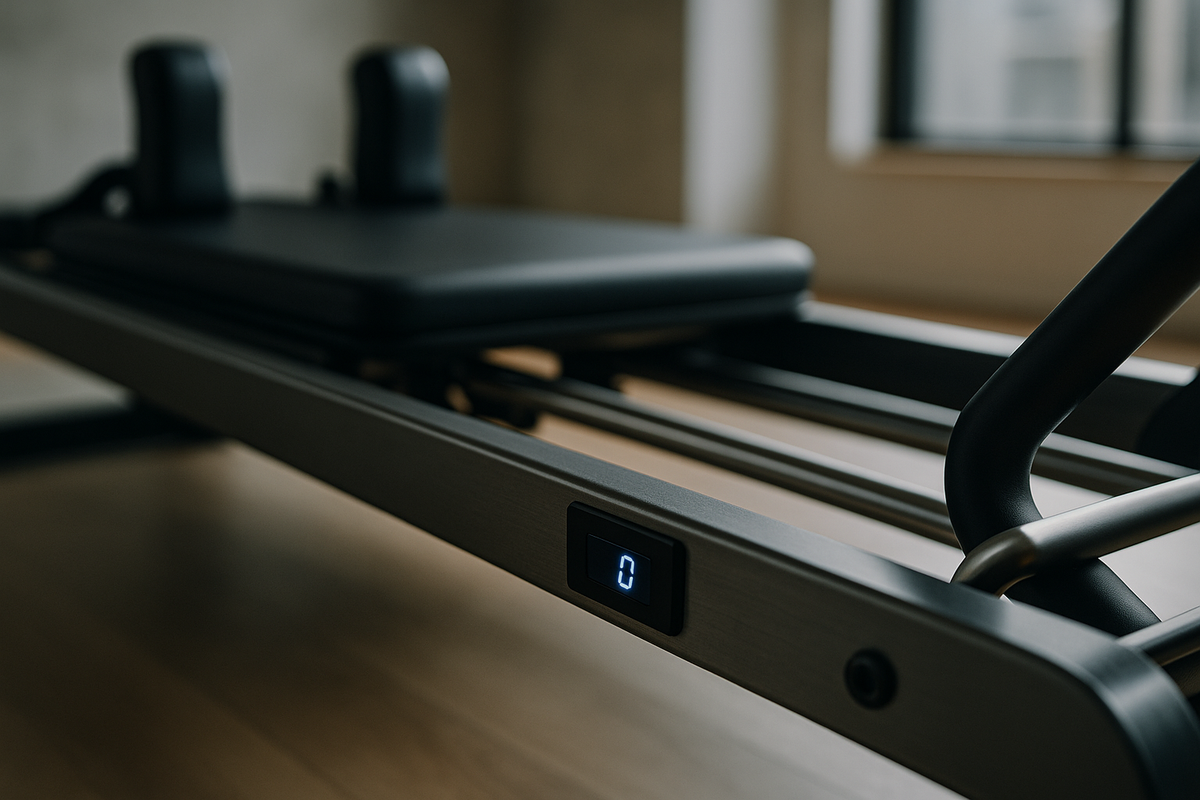
- Smart reformers deliver live performance metrics including carriage movement, resistance, power, cadence, and consistency tracking through touchscreens and intelligent sensors, with premium pricing 20–50% above traditional commercial reformers.
- Business model determines ROI, not equipment specs. The same $3,000 reformer generates $18,000 annually in one studio and $6,000 in another based on pricing, scheduling, and retention—strong studios achieve 100–200% first-year ROI regardless of connectivity.
- Client retention shows a 19-percentage-point advantage for studios using commercial-grade equipment (73% vs. 54% over 12 months), while smart features demonstrably increase motivation and progress tracking.
- Market positioning risk is real in 2026. Major players including iFIT's acquisition of Reform RX, Flexia, and Technogym's smart reformer launch signal that connected equipment is becoming table stakes in premium urban markets.
- Phased adoption and instructor training are critical. Lease rates of $90–$150/month per reformer allow studios to test connected units without $20,000–$60,000 upfront commitments, while staff must learn data interpretation alongside traditional cueing.
What Smart Reformers Actually Deliver Beyond the Hype
Connected reformers introduce objective measurement to a modality historically reliant on instructor observation and client feel. NordicTrack's Smart Spine technology measures carriage movement and resistance in real time, displaying power, cadence, and calories on integrated screens. Flexia Smart Reformer focuses on the three core Pilates metrics: control, speed, and consistency.
Reform RX's flagship model features a 21.5-inch HD touchscreen with over 150 on-demand workouts, delivering telemetry and rep tracking that standardizes coaching across sessions. One studio reported that live workout metrics motivated clients to push harder and track progress more diligently than verbal encouragement alone.
The technology does not replace instructor expertise. As industry observers note, the most effective outcomes combine objective data with observational skills and clinical reasoning, enhancing rather than automating the instructor's ability to assess and educate clients.
The ROI Reality: Why Your Business Model Matters More Than Features
A new commercial reformer costs $2,000–$5,000 delivered, with smart units commanding a 20–50% premium. For a studio purchasing 8–12 machines, the equipment bill runs $20,000–$60,000 before opening day. Lease rates typically run 2–5% monthly, translating to $90–$150 per month for a $3,000 reformer.
Yet the same reformer generates wildly different returns depending on the studio's business model. Well-performing studios achieve 100–200% first-year ROI, while anything below 80% signals pricing, occupancy, or cost structure problems. The equipment itself does not determine these outcomes—pricing strategy, scheduling density, lesson format, and client retention do.
A reformer in group classes generates $130–$250 per hour versus $15–$30 for cardio equipment, making it the most profitable piece of equipment per square foot in any fitness facility. Smart features may improve motivation and retention, but they cannot fix a studio charging $22 for a class that costs $28 to deliver. Understanding business model and margins remains the foundation of equipment ROI.
Who Should Invest: Market Positioning and Competitive Risk
The Pilates equipment market is rising 10% year-over-year, eclipsing $450 million by 2030. The U.S. reformer Pilates sector has evolved from fragmented studio ownership into a multi-billion-dollar institutional asset class anchored by Club Pilates and private equity-backed brands.
The competitive landscape shifted when iFIT acquired Reform RX, signaling intent to unite Pilates with other training modalities through a connected ecosystem. NordicTrack's Ultra 1 Reform RX-S is expected to launch in spring 2026 with a smaller footprint and accessible resistance levels. Technogym, a staple in high-end gyms, recently launched a smart reformer. Among Mariana Tek users, Pilates class offerings grew from 17% in 2021 to 45% in 2025, reflecting mainstream adoption and intensified local competition.
Editorial analysis, not reported fact: Premium urban studios competing directly with PE-backed franchises face the highest risk of appearing outdated without connected equipment. Independent operators in suburban or community markets may find traditional commercial reformers adequate if their retention and pricing models are strong. Franchisees often inherit equipment decisions from corporate, but those evaluating franchise vs. independent economics should weigh whether required equipment packages include connectivity premiums that independents can avoid or defer.
Practical Decision Framework: Lease, Buy, or Phase
Studios face three strategic paths. First, full upfront purchase of 8–12 smart reformers requires $24,000–$90,000 in capital but eliminates monthly lease obligations and positions the studio as technology-forward from day one. Second, leasing allows operators to test connected units with monthly payments of $90–$150 per reformer, preserving capital for marketing and payroll during the critical first year. Third, phased rollout combines traditional commercial reformers for the majority of the studio with 2–3 smart units for premium classes or workshops, creating differentiation without overextending budgets.
A study of 120 studios over 24 months found that commercial-grade equipment delivered 73% client retention at 12 months versus 54% for home-grade or mixed equipment. The quality baseline matters more than connectivity for retention, though smart features add measurable motivation when paired with strong instruction.
Operators must also budget for ongoing costs beyond acquisition. Connected gym equipment requires software subscriptions, update cycles, and staff training to interpret data and guide clients using metrics. Studios should plan for $200–$500 monthly in software fees and dedicate 4–8 hours per instructor for initial training.
Instructor Adoption and Operational Barriers
For instructors, smart reformers offer the potential to objectively measure progress and provide clients with tangible evidence of improvement. The opportunity lies not in replacing instructors but in enhancing their ability to assess, educate, and monitor clients. The most effective outcomes come from combining objective data with observational skills and clinical reasoning.
Operational concerns include data privacy, the need for consistent Wi-Fi or connectivity infrastructure, and the risk that instructors unfamiliar with performance metrics may under-utilize features or feel threatened by quantification of their teaching. Studios report that transparent communication about how data supports rather than replaces instructor judgment reduces resistance.
There is growing enthusiasm for hybrid experiences that combine studio instruction with connected at-home training, opening new ways for instructors to support clients beyond studio walls. Studios exploring hybrid revenue models may find that smart reformers provide the data infrastructure to deliver consistent programming across in-studio and remote touchpoints.
What This Means for Studio Operators
Editorial analysis, not reported fact: Smart reformers are not a magic bullet, but they are becoming table stakes in markets where competitors are investing in connected ecosystems and clients expect progress tracking as a baseline amenity. Operators in premium urban zip codes should evaluate whether the 20–50% equipment premium delivers differentiation that justifies higher class pricing or attracts corporate wellness contracts. Independent studios with strong retention and group reformer economics may defer investment until competitive pressure builds or clients explicitly request metrics.
The decision is not binary. A phased approach—outfitting one or two reformers with smart technology for signature classes or semi-private sessions—allows operators to test client demand, train staff incrementally, and build a marketing narrative around innovation without risking capital reserves. Studios should model whether the retention lift and potential pricing power from connected equipment justifies the lease or purchase cost within their specific occupancy and margin structure.
Finally, operators must resist the temptation to let equipment drive strategy. Smart reformers enhance a strong business model; they do not salvage a weak one. Studios with low occupancy, inconsistent scheduling, or instructor turnover should fix operational fundamentals before layering technology complexity. Those with solid margins, waitlisted classes, and clients asking for progress tracking have the business foundation to make connected equipment a strategic accelerator rather than an expensive distraction.
Sources & Further Reading
- iFIT Acquires Reform RX, Enters Connected Pilates Market, industry coverage of major platform consolidation
- Reform RX Connected Pilates Revolution, technology features and commercial market strategy
- NordicTrack Smart Reformer Pilates and Smart Spine Technology, product specifications and performance metrics
- Pilates Reformer ROI and Studio Earnings Analysis, financial modeling for studio operators
- Pilates Reformer Financing Guide: Lease vs. Purchase, capital strategies and monthly payment structures
- Commercial Pilates Reformer Cost: 2026 Pricing Guide, equipment cost benchmarks
- Pilates Reformer Machines for Professional Studios, retention study and equipment quality impact
- The Future of Smart Pilates: Can Technology Enhance Our Teaching?, instructor perspective on data integration
- PE-Backed Pilates Consolidation and Franchise Expansion 2026, market structure and competitive dynamics
Editorial coverage of publicly reported industry developments. The Pilates Business has no commercial relationship with any companies named.