Virtual Reality Pilates: Gimmick or Next Studio Tool?
VR Pilates apps show 50% higher engagement, but studio-level adoption lags. We analyze the engagement data, cost barriers, and pedagogical tensions.

Key Takeaways
- Virtual reality Pilates apps like Club Pilates on Meta Quest 3 and Alo Moves XR use volumetric 3D capture to recreate studio environments for home users, while FitXR integrates Pilates-inspired movements into gamified VR workouts.
- Engagement data shows promise: Les Mills BODYCOMBAT VR achieved 50% higher engagement rates than traditional digital classes, and peer-reviewed research found VR Pilates improved posture maintenance duration and promoted higher flow states than conventional training.
- Cost barriers remain steep: opening a boutique Pilates studio costs $150,000 to $350,000, with reformers representing 30 to 40 percent of startup investment; adding VR infrastructure or connected smart reformers at $3,000 to $7,500+ per unit compounds capital pressure.
- Studio-level adoption lags consumer apps: while approximately 37% of Pilates and yoga studios expanded hybrid online and offline systems in 2025, in-studio group VR reformer classes remain rare, with most VR Pilates applications targeting home use.
- Pedagogical tension persists: Pilates has traditionally been taught through oral, visual, and kinesthetic immersion, creating friction between tech-forward positioning and the discipline's focus on instructor-client tactile correction and breath cuing.
What Virtual Reality Pilates Actually Delivers
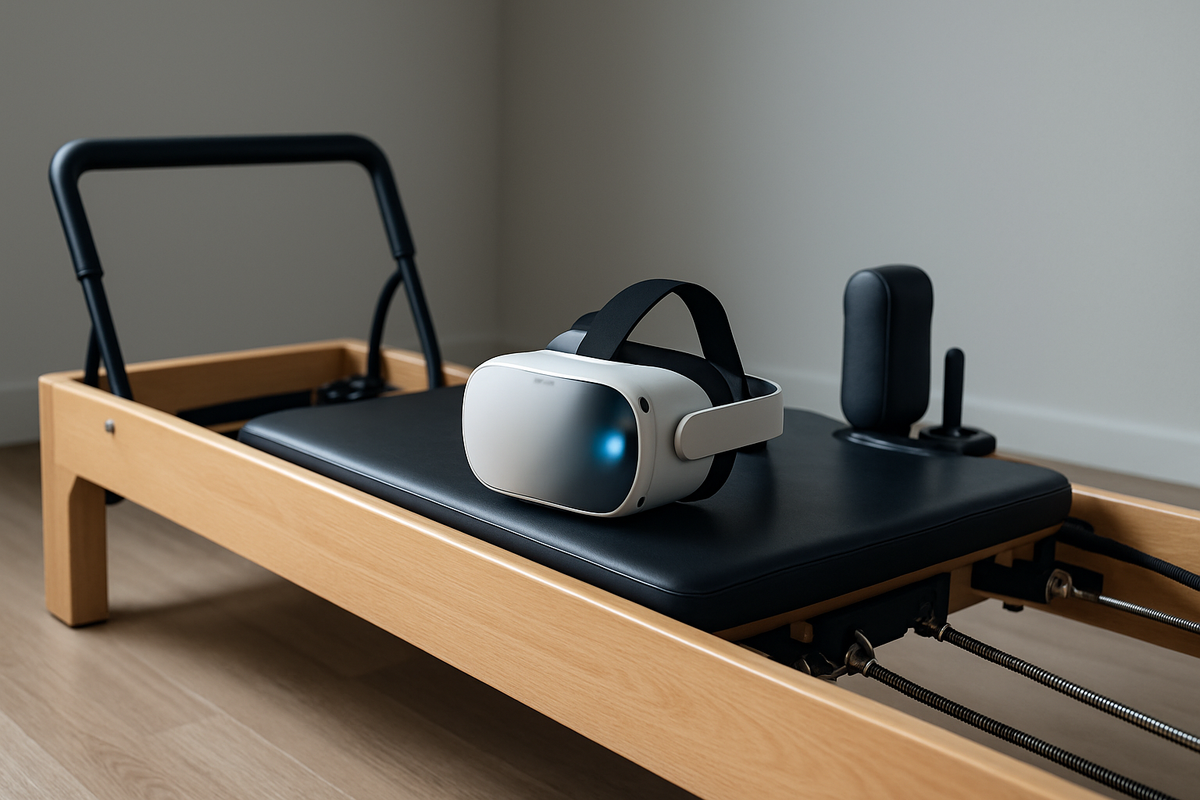
Virtual reality Pilates exists in two distinct forms: immersive home workout apps and connected studio equipment. Alo Moves XR on Meta Quest 3 uses volumetric 3D capture to place users inside a photorealistic studio environment, mimicking the visual and spatial cues of a high-end boutique class. Club Pilates launched its own Meta Quest app as part of Xponential Fitness's broader VR strategy, bringing branded class sequences into consumers' living rooms.
On the equipment side, REFORM STUDIOS in Chicago introduced the REFORMRX, marketed as the world's first smart reformer. These connected machines layer performance tracking, real-time form feedback, and personalized programming onto the classical reformer experience. The promise is compelling: technology that enhances rather than replaces human instruction, offering data-driven insights while preserving the tactile, breath-centered foundation of the method.
The Engagement Case Is Stronger Than Expected
Early data suggests VR delivers measurable engagement gains, particularly for consistency and user satisfaction. Les Mills reported that its BODYCOMBAT VR platform saw 50% higher engagement rates compared to traditional digital classes, with users logging more frequent workouts and reporting stronger satisfaction scores. While this data comes from a cardio-based format rather than Pilates specifically, it demonstrates VR's ability to solve the motivation problem that plagues on-demand fitness.
More directly relevant, a peer-reviewed study published in 2023 found that VR Pilates training improved the duration of posture maintenance and promoted a significantly higher degree of flow compared with conventional Pilates training. Flow—the immersive mental state associated with peak performance and intrinsic motivation—is notoriously difficult to achieve in home fitness settings. If VR can reliably induce flow states, it addresses one of Pilates' core appeals: the meditative, focused quality of mindful movement.
Why Immersion May Matter for Pilates Specifically
The Pilates paradigm is shifting toward consistency over intensity and longevity over burnout, according to industry leaders interviewed in early 2026. This philosophical alignment with sustainable, mindful practice makes Pilates a better candidate for VR than high-intensity interval training or other modalities that prioritize metabolic stress over mental engagement. Fitness brands are embracing "exertainment" to stay relevant to Gen Z, 86% of whom report that their passions have diversified since the pandemic. VR Pilates sits at the intersection of these trends: experiential, photogenic, and aligned with wellness values rather than aesthetic extremes.
The Studio Economics Do Not Yet Add Up
Despite promising engagement data, the capital investment required to integrate VR into a brick-and-mortar studio remains prohibitive for most operators. A standard boutique Pilates studio in 2026 costs $150,000 to $350,000 to open, with reformer equipment accounting for 30 to 40 percent of total startup costs. Adding VR infrastructure—headsets, computing hardware, dedicated space, software licensing—represents a second wave of capital expenditure in an already tight-margin business.
Connected smart reformers range from $3,000 to $7,500 or more per unit, compared to $2,500 to $4,000 for a quality traditional reformer. For a 10-reformer studio, the premium adds $5,000 to $35,000 to equipment costs alone. The return on investment hinges on whether smart features command premium pricing or drive measurably higher retention, neither of which has been demonstrated at scale in Pilates-specific contexts.
Where VR Adoption Is Actually Happening
Approximately 37% of Pilates and yoga studios expanded hybrid online and offline wellness coaching systems in 2025, but this statistic encompasses virtual livestreaming, on-demand video libraries, and member apps—not immersive VR. Many forward-thinking boutique gyms are incorporating virtual reality workouts with little more than smart planning and a growth mindset, yet concrete examples of studios running group VR Pilates classes remain scarce outside of pilot programs and franchise innovation labs.
The current reality is that major franchise brands like Xponential Fitness are betting on consumer home adoption through apps on consumer VR headsets, not in-studio experiences. This positions VR as a member engagement and home practice tool rather than a differentiated studio offering. Independent operators face a strategic question: invest in VR to compete with home alternatives, or double down on the irreplaceable value of hands-on instruction and community?
The Pedagogical Tension Between Tech and Touch
The Pilates method has traditionally been taught directly from one person to the next in an oral, visual, and kinesthetic fashion, with Joseph Pilates training apprentices through immersion in his studio. This lineage-based pedagogy emphasizes tactile correction, breath cuing, and the instructor's ability to read subtle compensatory patterns in real time. VR excels at visual and auditory feedback but cannot replicate the hands-on adjustments that distinguish skilled Pilates instruction from algorithmic coaching.
Instructors are already using tools like ChatGPT to write class plans and organize materials, but questions remain about whether efficiency gains erode the craft's tacit knowledge. Industry voices emphasize that smart features should enhance, not replace, self-awareness and personal effort, and that live instruction remains invaluable for nuance and emotional support. The risk is that VR becomes a marketing differentiator that undermines the discipline's core value proposition: expert human guidance through complex, precise movement.
What This Means for Studio Operators
Editorial analysis, not reported fact:
Virtual reality and connected reformers are genuine innovations, not pure gimmickry, but they demand operator-specific strategic thinking. Franchise-backed studios with corporate R&D budgets can afford to experiment with VR as a member acquisition and home practice retention tool. Independent operators should evaluate VR through three lenses: capital efficiency, brand differentiation, and pedagogical fit.
For studios competing primarily on convenience and variety—particularly those serving younger, tech-forward demographics—smart reformers may justify their premium if marketed as personalized performance tracking rather than automation. For studios whose brand centers on lineage, craft, and hands-on instruction, investing in instructor education and small-group programming will likely generate better returns than technology that risks diluting the teaching relationship.
The most pragmatic near-term application may be hybrid: offering VR-based home practice apps as membership add-ons to extend studio engagement between in-person sessions, rather than attempting to retrofit physical spaces with expensive immersive infrastructure. The data on engagement and flow states is compelling, but the business case depends on whether your studio's competitive advantage comes from experience innovation or teaching mastery. Choose based on your operator profile, not industry hype.
Sources & Further Reading
- Pilates and Yoga Studios Market Report, data on hybrid system adoption in 2025
- Club Pilates VR App on Meta Quest 3, Xponential Fitness's consumer VR offering
- Les Mills Research on VR Fitness Engagement, BODYCOMBAT VR case study
- Peer-Reviewed Study on VR Pilates and Posture Maintenance, National Institutes of Health publication
- Cost Analysis for Opening a Pilates Studio in 2026, capital investment benchmarks
- Reimagining Reformer Pilates, industry perspectives on technology and tradition
Editorial coverage of publicly reported industry developments. The Pilates Business has no commercial relationship with any companies named.